A Guide to Cross Country Bike Touring

It’s the six year anniversary of my cross country bike trip and I’m finally getting around to writing the post I’ve had on my mind since I finished: A Guide to Cross Country Bike Touring. While I won’t dwell too long on my personal journey (you can find those details here), I’m hoping for this to be a helpful how-to guide for people who are contemplating a biking adventure of their own.
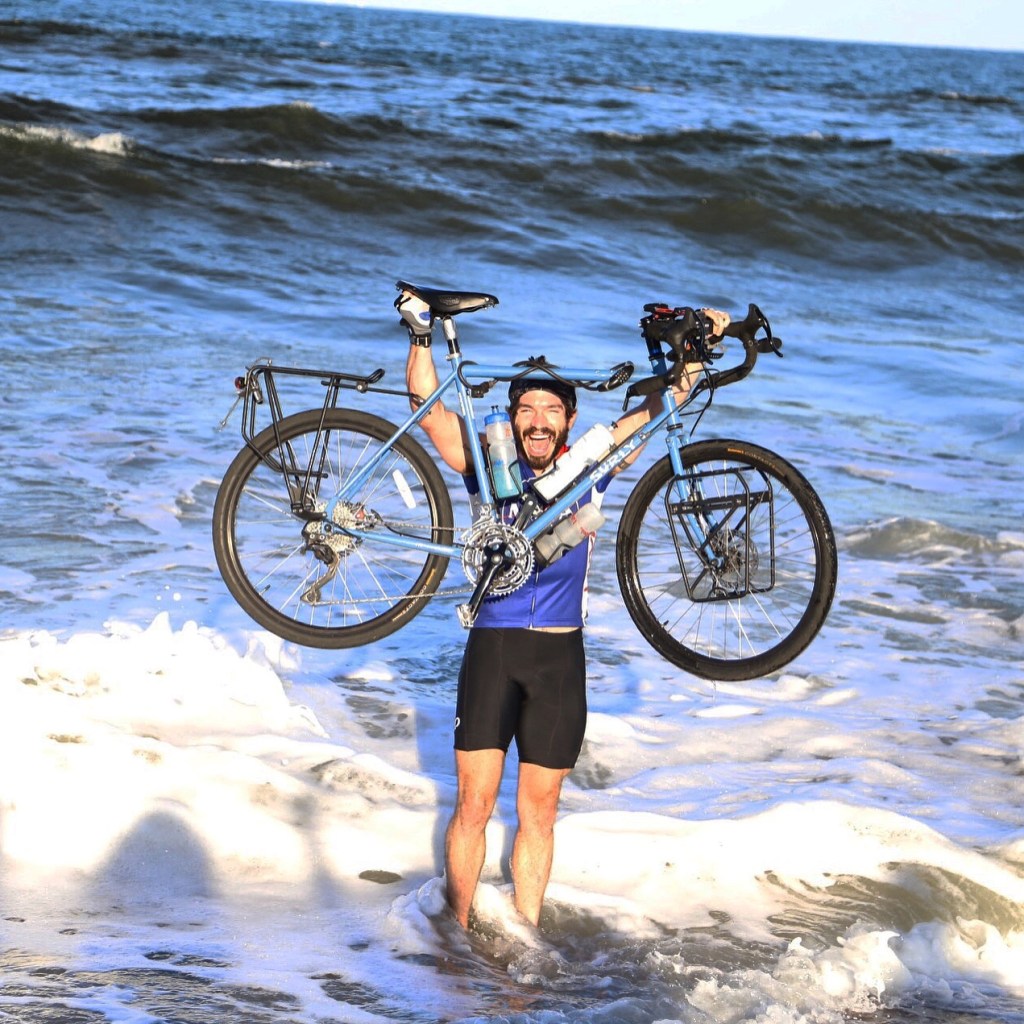
Finish line photo. Atlantic Ocean, Virginia Beach, VA.

The starting point for preparing for your bike tour is to have an idea of how far and where you’ll be going and to decide whether you’ll do a supported or non/self-supported ride. This blog post is specifically geared towards long (cross country) and self-supported trips since the planning and logistics there can feel overwhelming to first timers (I was there!). Maybe a more appropriate title would have been: A Guide to Self-Supported Long Term Bike Touring, but it didn’t feel as catchy 🤓.

Let’s start by saying that riding your bike across the country will be an unbelievable experience, providing you with a lifetime’s worth of memories and stories and a unmatchable sense of accomplishment. And you can do it. If you’re doubting that second point because you’ve never done it and you don’t know where to start with the planning process, my goal is to convince you otherwise with this post. Read on to learn more about planning your route, getting/packing the gear that you need to support yourself on the trip, and overcoming the daily challenges on the road.

Since I may have gotten a little carried away with the length and level of detail in this post 😅, I’ve included a table of contents to help you skip around:

  1. Committing to the Trip
  2. Route Planning
    1. Following a well established bike route versus charting your own path
    2. Choosing your start and end points
    3. Choosing the time of year
    4. Planning your daily rides
  3. Gear
    1. The Essentials
    2. Bike Tour Gear Inventory
    3. Packing the Gear
    4. My Top Five Favorite Gear
  4. On the Road
  5. FAQ
    1. How often did you camp vs. hotel vs. Airbnb vs. other?
    2. How do you bike through the Rockies with all that gear!?
    3. How much physical training is required to embark on a long term bike tour?
    4. How much clothes did you pack?
    5. What were the biggest surprises?
  6. Closing
  7. Acknowledgements

Committing to the Trip

We’ll start with potentially the most important piece of advice: commit to the trip before you feel ready, because you will never feel ready. As far as I can remember – I read this advice here while I was researching bike touring, and it was exactly what I needed to hear when I was feeling totally overwhelmed as a bike touring noob planning a cross country trip.
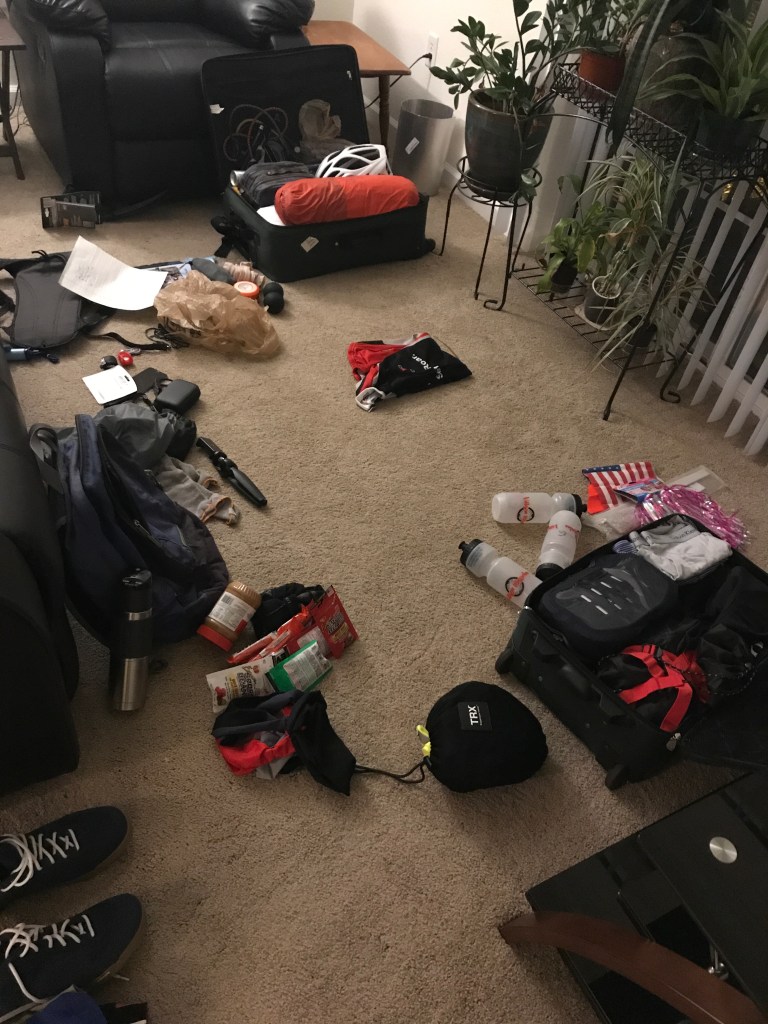
My living room leading up to the trip – my head was spinning trying to make last minute gear decisions.

It is impossible to work out every detail of the daily routes and accommodations of a multi week bike tour before you leave. And even if you could, it’s risky to set your daily accommodations in stone too far in advance when there is a good chance you’ll experience some delays due to weather, bike repairs, etc. at some point. I had the first three nights of lodging/camping arranged as the trip started, that’s it.

Aside from route details, it’s also easy to go down a never ending rabbit hole of research about the gear you’ll need to support yourself on your tour. Remind yourself that you’re not stuck with same gear you had to start your trip – you can easily pick up new items at local bike shops on your route (or have gear shipped to you), or ship any gear that you’re finding to be unnecessary back home to save on space/weight. It’s tough to know exactly what’s important until you’re out on the road.

All of this is not to say that you shouldn’t take your pre-trip research seriously, but a reminder that you’ll need to be comfortable embracing a healthy amount of uncertainty heading into your trip. And it’s totally normal to feel like you aren’t ready. For me, I had a ton of self doubt as the trip approached, sometimes waffling about backing out. As I boarded the plane to fly out West to begin my trip, I couldn’t help but think “what the f#&$ am I doing?”. But I’m sure that I would still have had that same feeling with an infinite amount of planning. I ultimately made it and I’m so thankful to this day to my 2017-self for committing before he felt ready.

Route Planning

Let’s talk about planning the route you’ll take on your tour, both the big picture choices you’ll make before you set out on your journey as well as the finer details of each day’s ride.
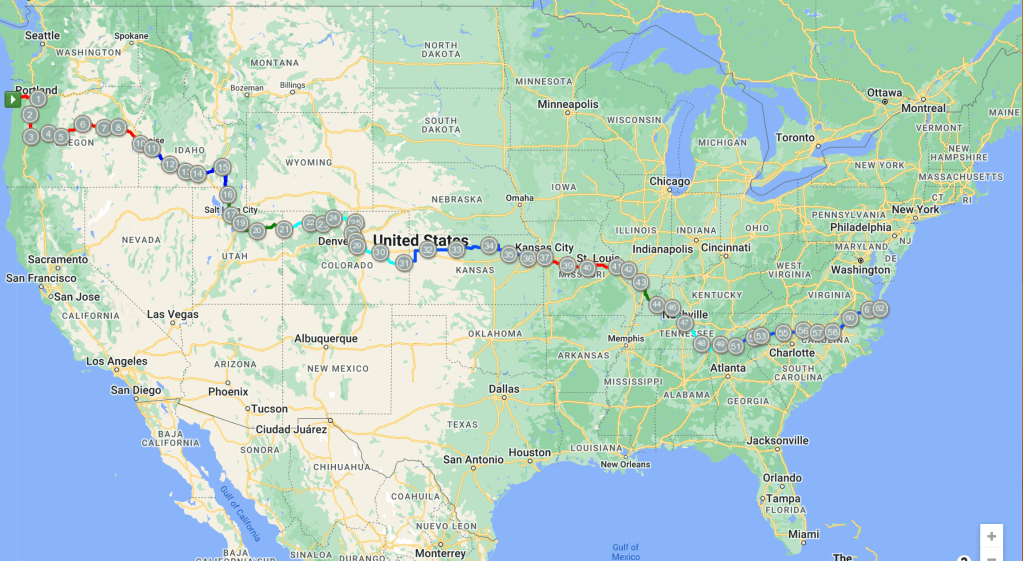
My route across the country, you can see it in detail here.

Following a well established bike route versus charting your own path
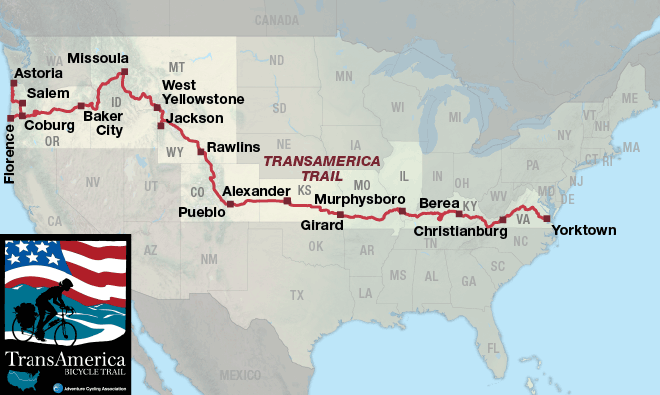
The first decision to make is whether or not you will follow a well-established bike route. For a cross country tour, the TransAmerica Trail is arguably the most popular (see Adventure Cycling Association for other routes around the U.S.).

There are a ton of benefits to sticking with an established route. First and foremost, it’s much safer. These routes are thoroughly researched by cartographers to contain more bike-only trails and bike-friendly roads. Plus, since they are well traveled by other cyclists, motorists along the route are more accustomed to respecting bike lanes. The routes will also contain bike-friendly inns, campgrounds, and shops, and you’ll be likely to cross paths with many other cyclists on the same (or similar) journeys.

On the other hand, the primary benefit of blazing your own trail is the added freedom and flexibility to customize your trip. Always wanted to sightsee in St. Louis? Have some friends you want to visit in Chicago? You can make a list of cities that you want to visit and then see how many of them you can hit on a reasonable route. The downside is that the added freedom requires significantly more time/effort to plan a safe and bikeable route.

I opted to follow my own route so I could have the extra flexibility. While I’m still happy with the choice to this day, I totally underestimated how much planning and logistics would be involved. See the following sections for some advice on the planning process.

Choosing your start and end points

If you’re biking one big loop (or an out and back) that starts and ends at home, then you already have this figured out. But if you’re doing a one way trip like a cross country tour, then you’ll need to choose end points of your route and decide which direction you’ll go.
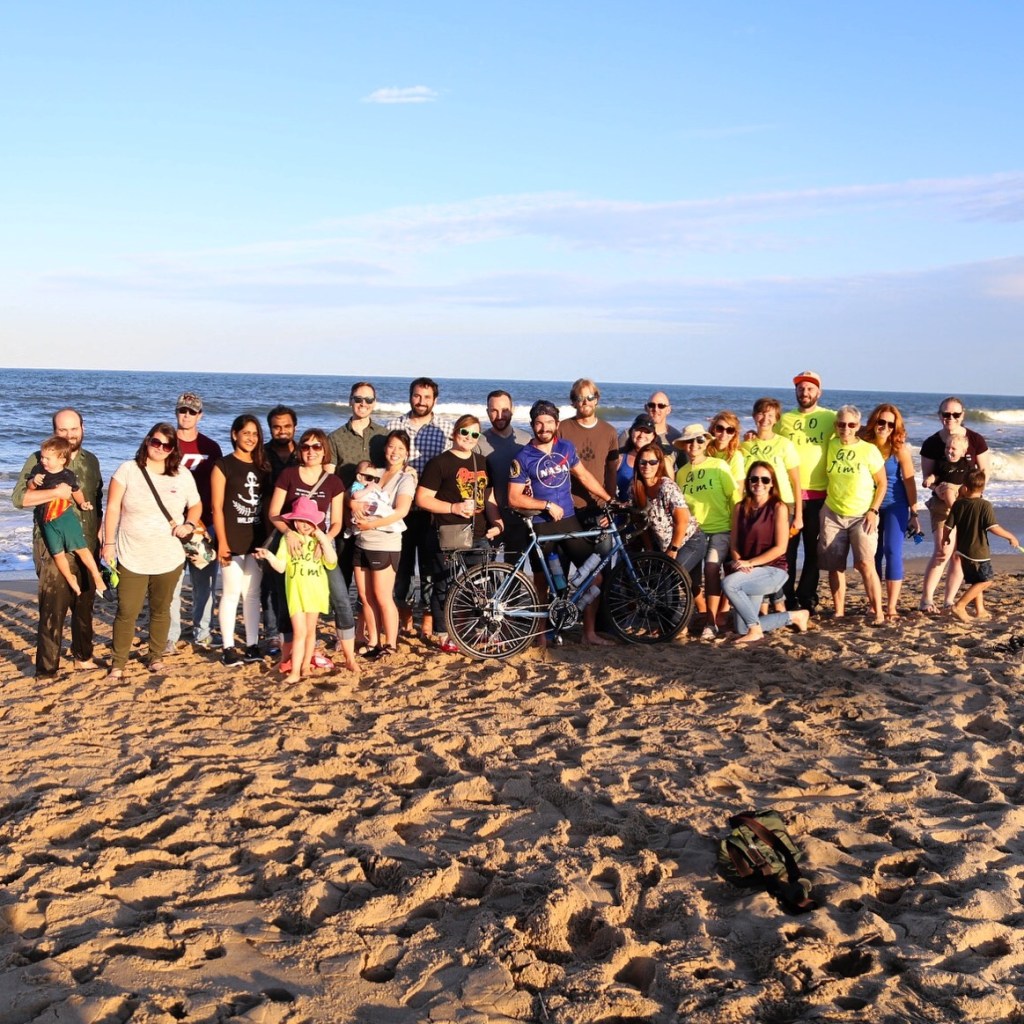
My welcome back party on the East Coast

The main consideration here is the logistics required to travel from home to your starting point or from your end point back home with your bike and all of your gear. If you don’t live close to either end of the route, you’ll have to figure out these logistics twice for the start and finish. Otherwise, it is definitely easier and more convenient to get the traveling done upfront to your start point and then end your tour at home (or nearby). Plus you have the added bonus of being able to celebrate with friends and family when you finish your trip 😎.
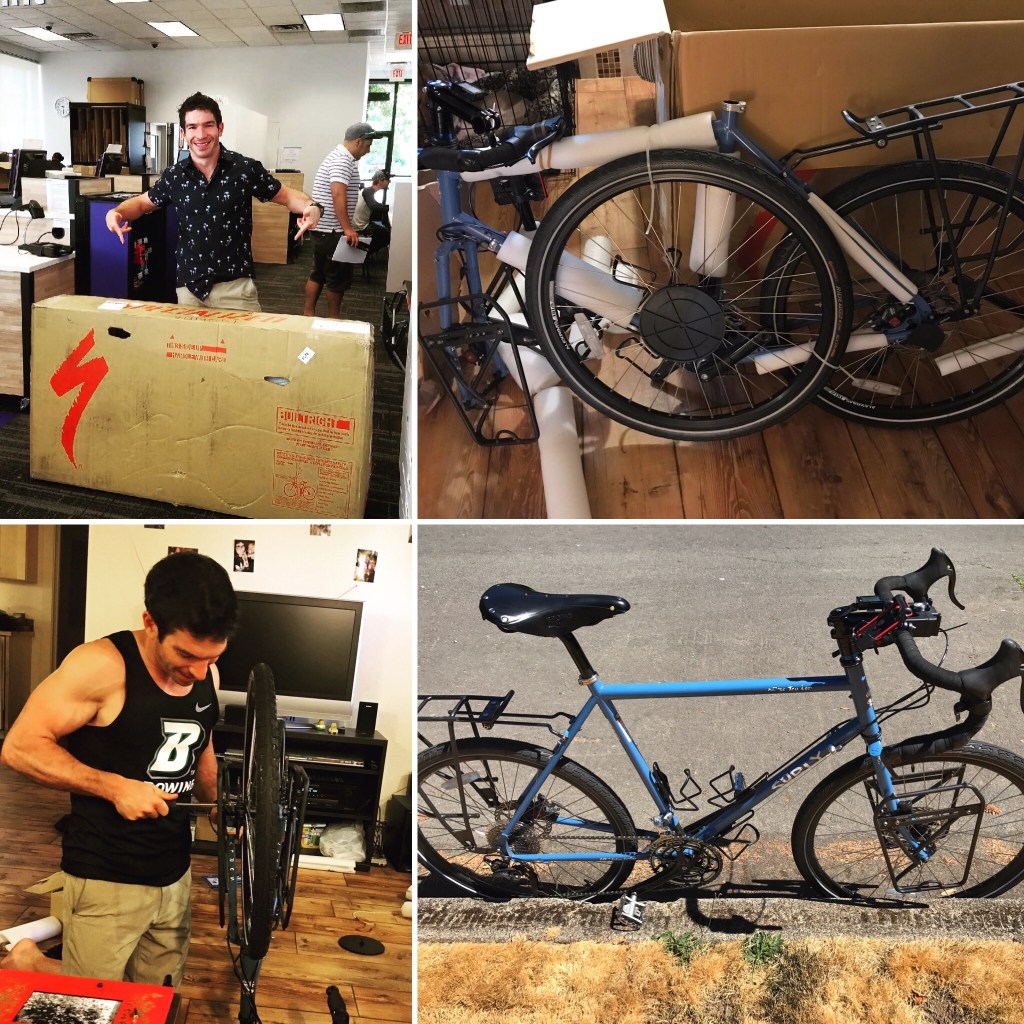
Reuniting with my bike after shipping it from Virginia to Oregon to start my cross country tour.

Since I live on the East Coast in Virginia, I opted to finish my ride there and travel to Oregon to start the trip. I bought a one way plane ticket out West and shipped my bike a few days ahead of time (a local bike shop helped with the disassembly/packing/shipping for around $100 total) and picked it up at the UPS store in Oregon. I packed all of my gear in an old suitcase I was okay with donating once I got there.

Choosing the time of year

With your route sketched out, you now need to decide what time of year you’ll embark on the journey. This of course first depends on your work flexibility, family obligations, and other life commitments.

The next important consideration is what the weather will be like along your route at different times of year. You’ll want to minimize the likelihood of riding through extreme heat or cold, or excessively rainy weather, if possible. For example, if you’re taking a northern route across the country (like the TransAmerican Trail), you’ll likely want to do so during the summer.

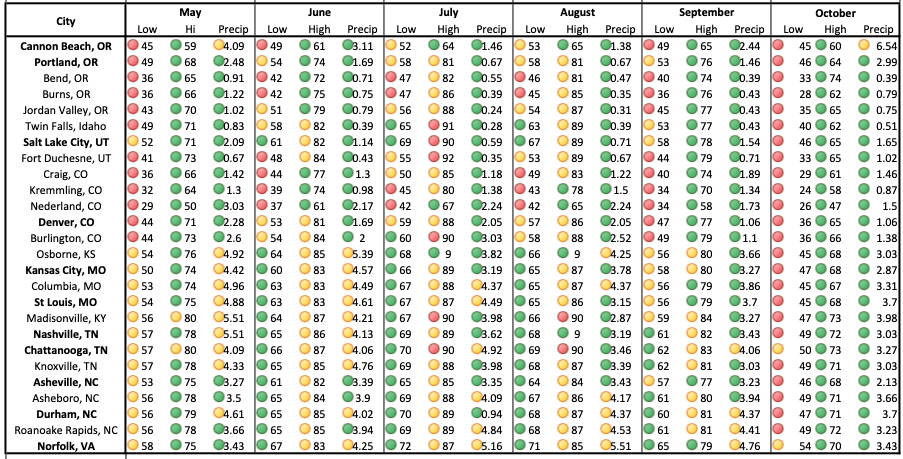
To better time your trip, you can jot down the historical weather in a handful of cities along your route for the months you’re considering. From there, you can see if you can adjust your start date to decrease your chances of biking through bad weather. Look in particular at places known for more extreme weather, like the Rocky Mountains.

See below for a screenshot of the spreadsheet I created to do this for my trip, color coded for good (green), decent (yellow), and bad (red) conditions (Note: nerding out on this process like I did is definitely not required 🤓). I left for my trip at the end of July and finished at the end of September, wanting to avoid colder weather in the months of May and October along my route.
Planning your daily rides

Now that we’ve covered the “big picture” route planning for your bike tour, we need to talk about planning the details of your daily rides. As I alluded to earlier, one of the biggest surprises for me was how much time and effort this would take, in large part because I wasn’t following an established bike route.
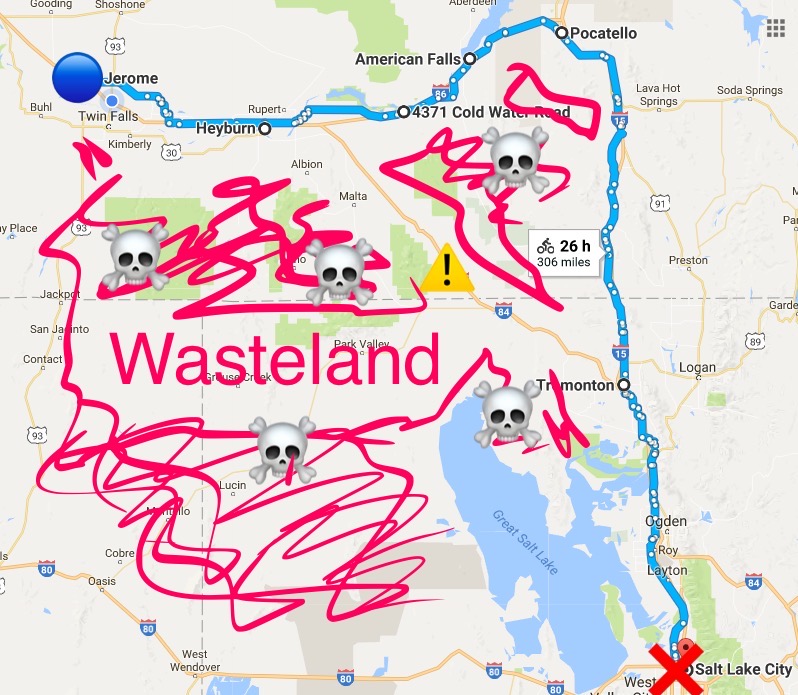
Trying to navigate from Jerome, ID to Salt Lake City, UT after learning that much of southern Idaho and Northern Utah is impassable desert and interstates.

When I pictured my daily rides before I embarked on my journey, I imagined simply biking all day until I was tired and then stopping at the next town to find accommodations for that night on the fly. Turns out that’s not very practical for much of the country where you can bike 50-100 miles sometimes without seeing any civilization – you’d easily find yourself stranded or sleeping on the side of the road without planning ahead.

I also expected to rely on Google Maps bike directions for most/all of my navigation, not knowing it would lead me into many dead ends and even on to a live firing range in a desert one day 🤠. It’s worth pointing out that I took my trip in 2017 so it’s possible they are more reliable these days. See below for some examples of Google Maps bike direction fails from my trip:
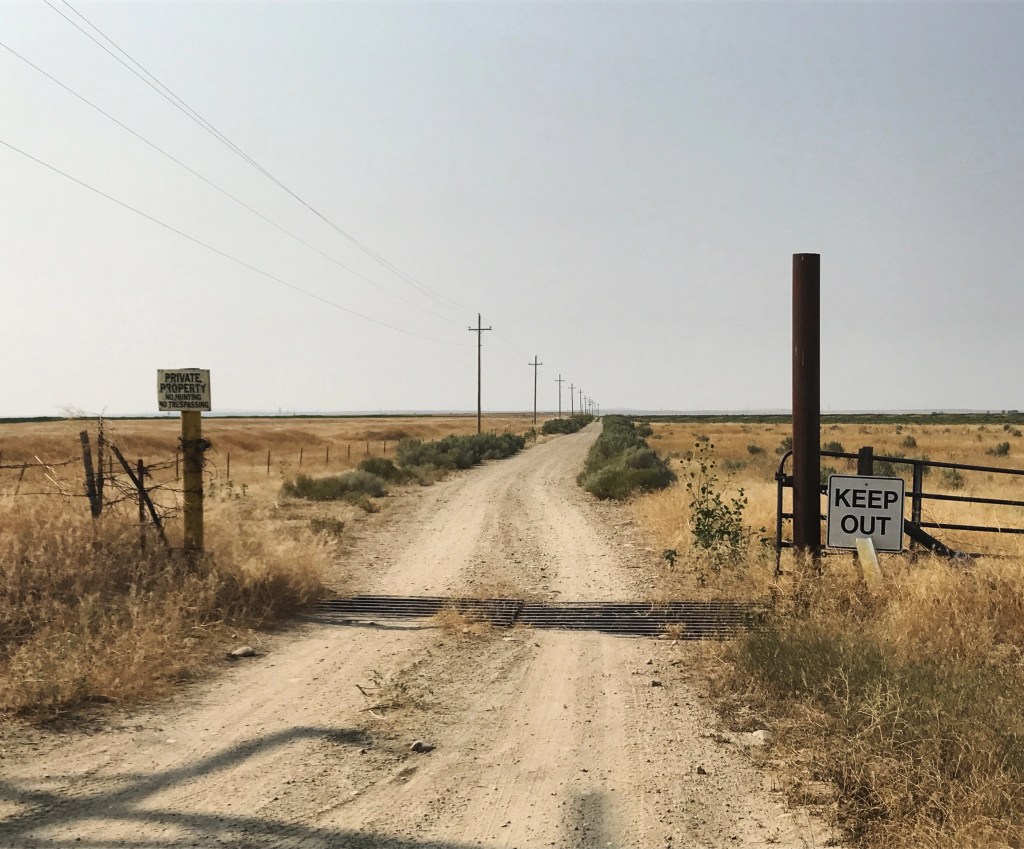
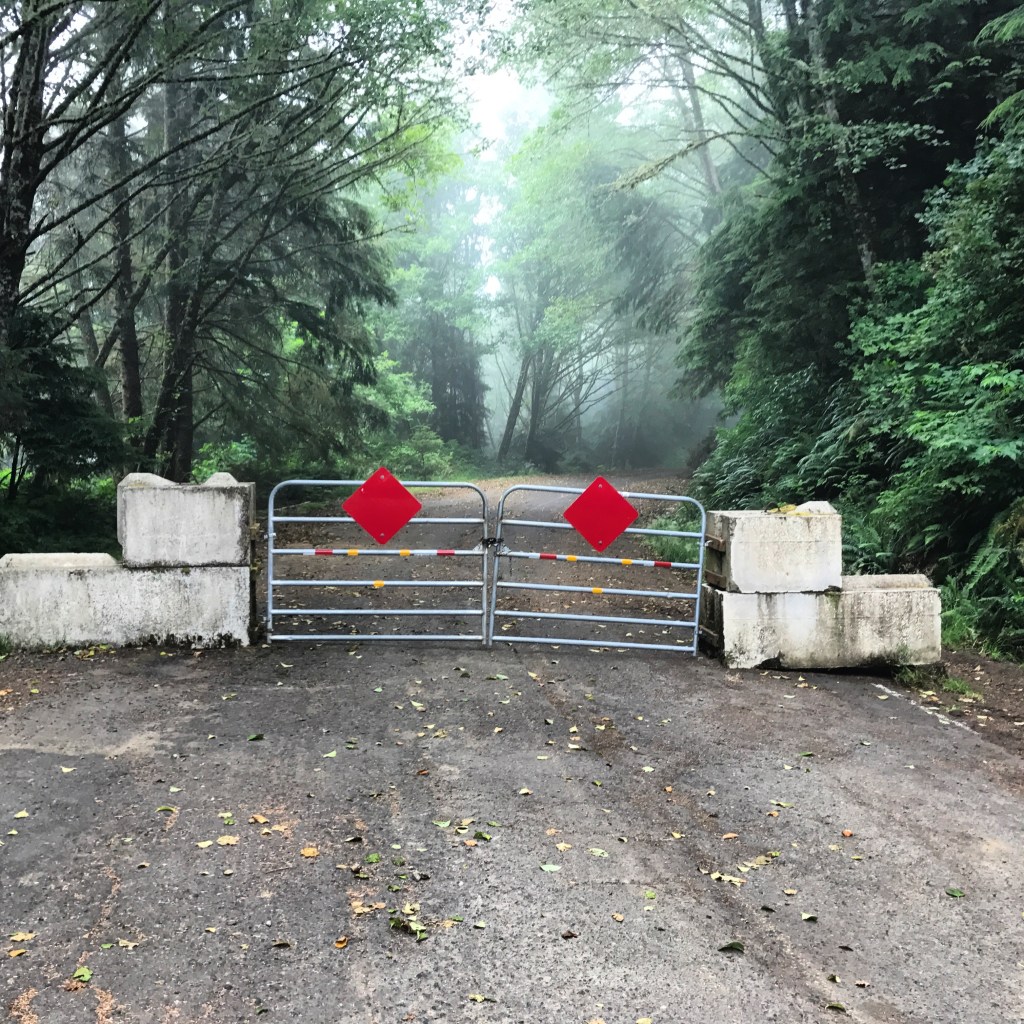
All of this is to say, you need to take daily ride planning seriously on your bike tour, especially if you’re not following a popular bike trail. Here are some tips for doing so:

  • Plan your upcoming accommodations in short, manageable segments. The sweet spot for me was planning 3-5 days/nights at a time. Use rest days or days with shorter rides and more free time to work on these logistics.
  • Go beyond simply following Google maps. Use Google maps bike directions as the starting point. It will avoid obvious hazards like interstates. But as I mentioned above, you don’t want to rely solely on these directions. Go to satellite view in Google Maps and give your route a thorough scan, looking for any dangerous/impassable sections. Make any manual adjustments to the route as necessary. You can then save the directions that contain any modifications you’ve made so that you can follow them specifically when riding – see here for instructions on that.
  • Strategize nutrition/hydration pit stops for longer rides. Make sure you’ll pass through enough civilization to restock on water/food, and if not, make sure you pack extra of each with you for long trips. When you’re out West especially, you may need to do some zig-zagging and extra mileage to make sure you pass by gas stations or stores to re-up your supplies.
  • Ask a friend/family member to help you do route recon. I had a good friend that was invaluable for helping with the logistics/planning on my trip (nicknamed “Mission Control”). This not only gave me peace of mind on the route I was following, but freed up more time to just enjoy my journey.

Gear

You could write an entire E-Book on bike touring gear! So I’m doing my best to not get too carried away in this section….

The Essentials

First thing’s first: you need a durable, dependable bike to take you the distance and large enough panniers (bike bags) to carry all the gear you need to support yourself on the tour.
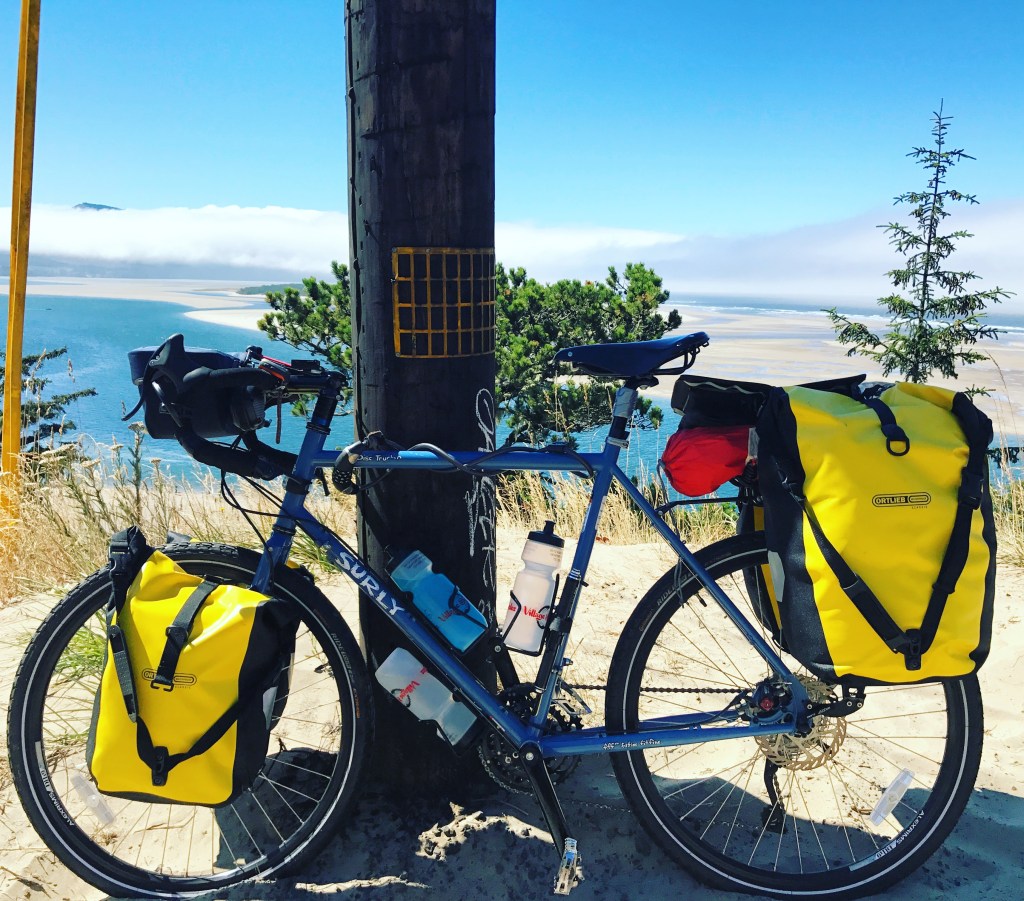
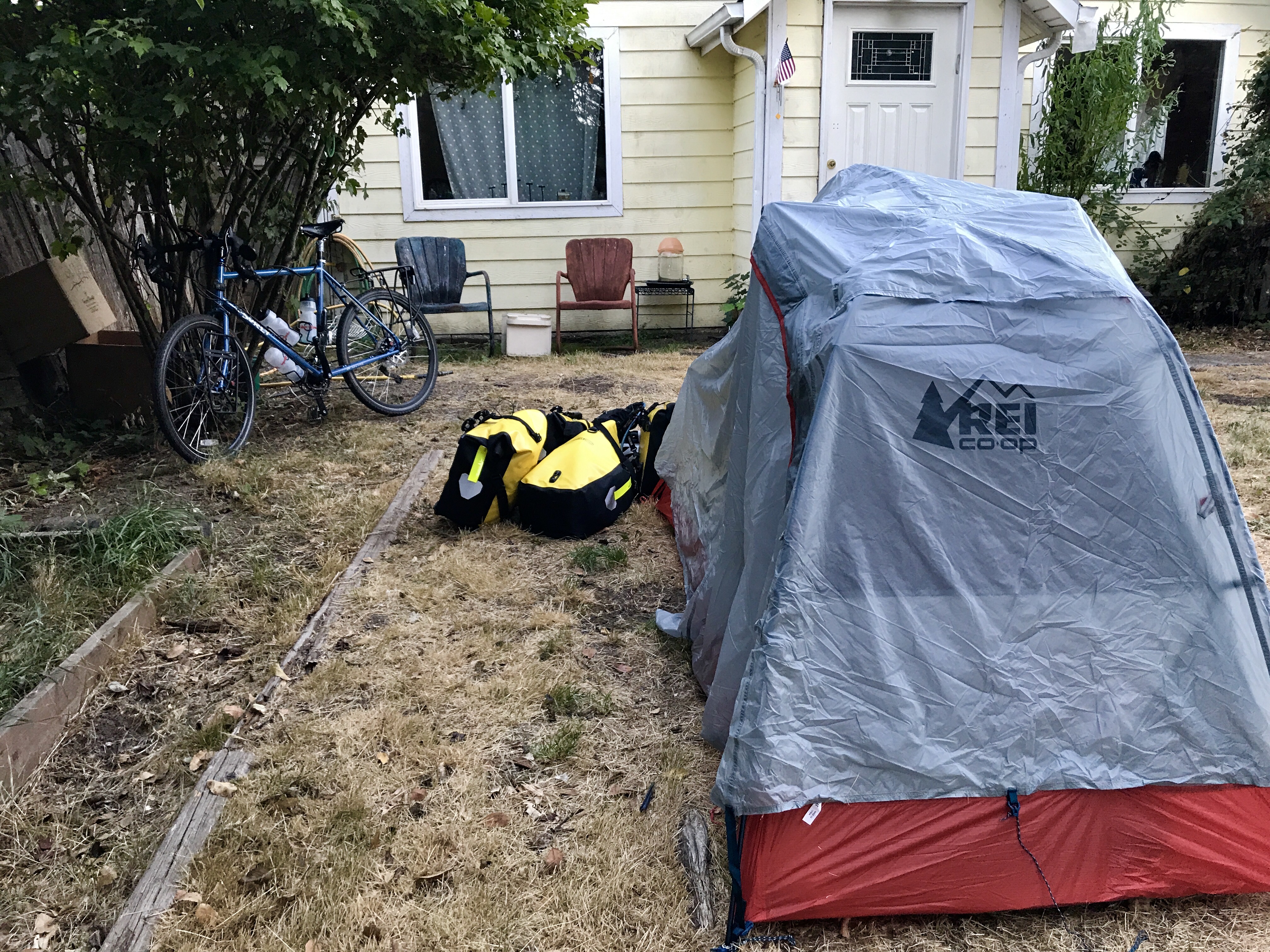
My cross country rig: Surly Disc Trucker bike (“Frank the Tank”) with Ortlieb Front/Back-Roller Classic panniers (chose bright yellow for added visibility). I also upgraded the seat to a Brooks firm leather bike saddle.

Get yourself a touring bike if you don’t have one already. Touring bikes typically have steel frames so they’re sturdier and can carry heavy loads (your gear), have fatter tires to handle dirt/gravel roads that you’ll likely come across, and are built for weather-proof riding (disc vs. rim brakes, for example). In addition to choosing the right bike for you, make sure to get the right fit to the bike with a professional adjustment prior to your trip.

While touring bikes are shaped to provide more comfort for long rides, you may want to also test out a few upgraded bike seats before your trip… your butt will thank you a few hundred miles into your trip 😜.

To carry all of your gear, you’ll need to get yourself a set of front and rear panniers, along with the racks for mounting them to the bike. I suggest splurging a bit here for waterproof bags to keep your gear dry on rainy rides. I also recommend adding a handlebar bag to carry smaller items that you use more frequently on your rides (phone, wallet, snacks, etc.).

Last but not least – you’ll need a quality bike lock to protect your ride!

Bike Tour Gear Inventory

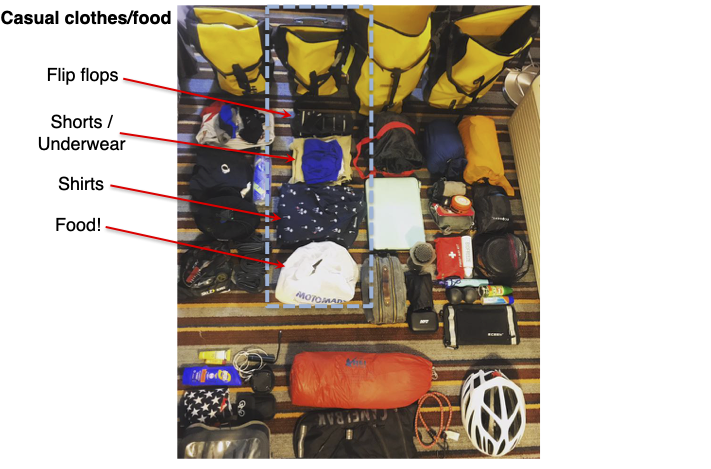
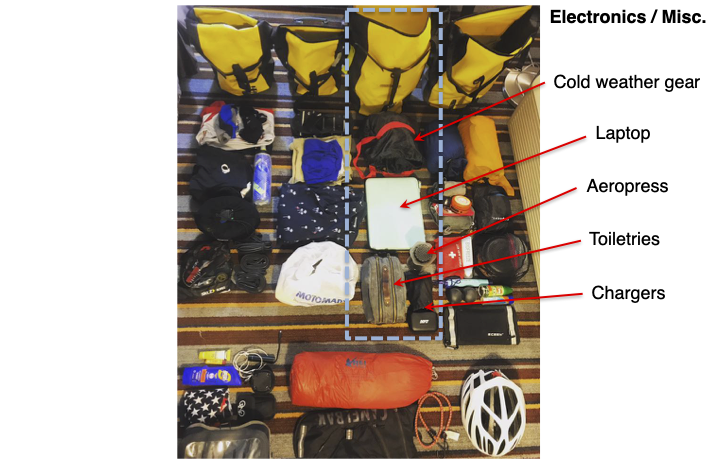
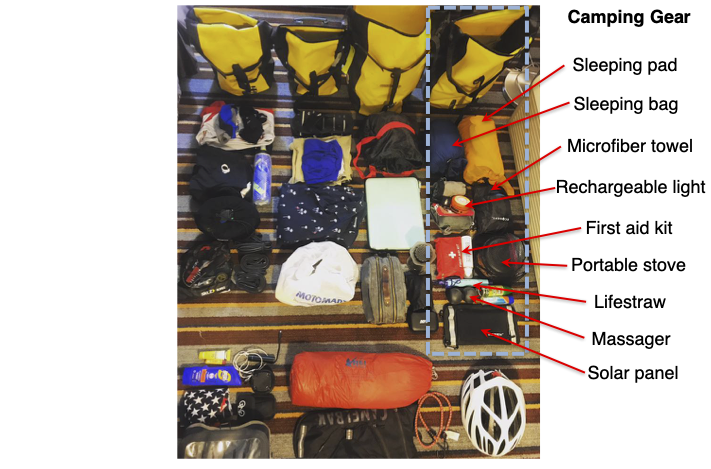
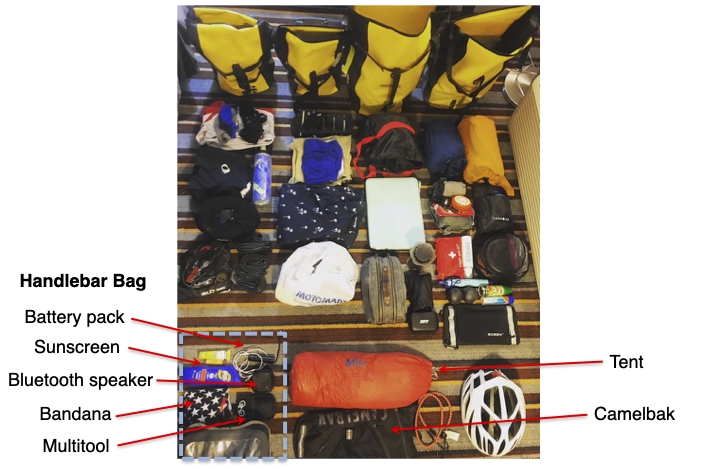
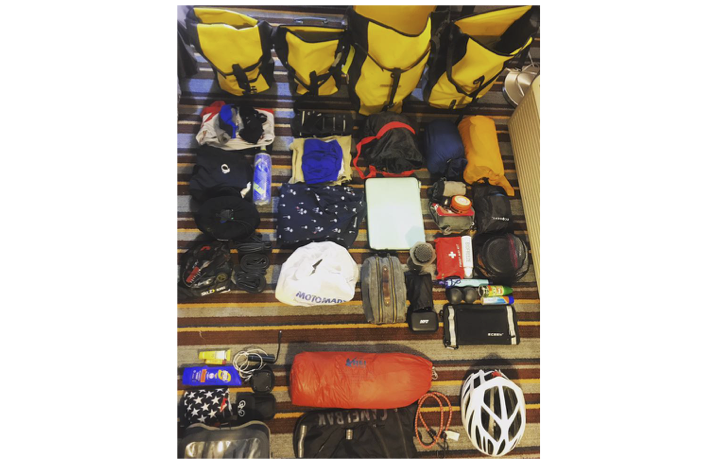
Rather than list out and talk about alllllll suggested gear for a bike tour in gory detail, I’m opting instead to provide a gallery of my cross country gear in it’s entirety below. I’ve highlighted the different groups of gear (biking clothes/tools, casual clothes, camping gear, etc.) in each bike bag along with labels for most of the items. Click a picture to view the gallery for details!:
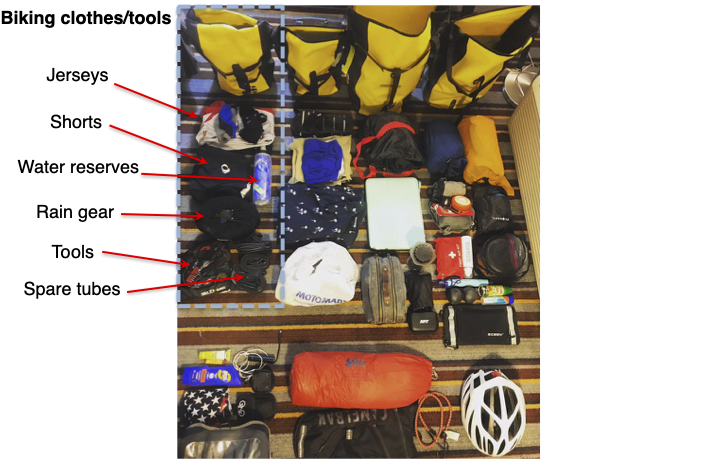
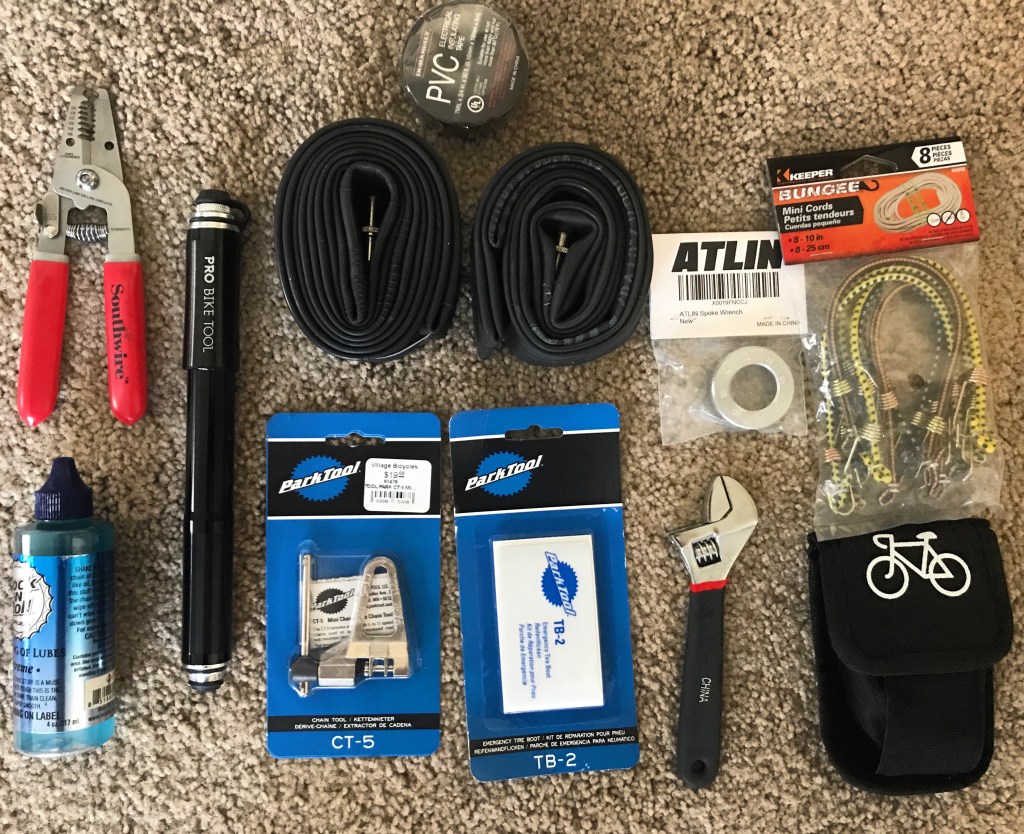
The bike tools I packed for the trip: wire cutters, lube, portable pump, electrical tape, spare tubes, chain tool, tire patches, spoke wrench, bungee chords, multitool.

A couple items not pictured above:

  • Bear spray: I had this for the first few weeks of my trip before I had an accidental discharge in my bike bag and had to throw it away 🙈. Thankfully I never needed it prior, but it was comforting to have it when camping in relatively desolate areas out West.
  • Duct tape: I’ll pass on a pro tip that I read a couple weeks before I started my trip: wrap a healthy sized chunk of duct tape around your seat post so you have it around just in case without taking up extra space in your bike bags👌.

Packing the Gear

Once you’ve got a handle on the gear you need for the tour, packing it is a whole nother can of worms! Here’s a few general goals/pointers to keep in mind for packing:

  • Make frequently used items more accessible. Put your phone, sun screen, portable charger, etc. in the handlebar bag. Pack higher priority items (food) towards the top of your panniers with less frequently used items (extra bike clothes) at the bottom. You’ll also may want to put more frequently used items in the front panniers vs. the back since they are typically easier to access.
  • Group your gear strategically. Beyond just grouping similar items (all of your camping gear) to be more organized, consider having your bags designated as clean & dry or dirty & wet. For example, I kept my clean casual clothes in the same (clean stuff) bag as my food while combining bike tools, rain gear, and bike clothes in the same (dirty stuff) bag.
  • Keep your weight balanced. Your weight should ideally be equally distributed from left to right and from front to rear bags (or slightly more weight in the rear). Also aim to place heavier items towards the bottoms of your bags to keep your center of gravity low. Weighing and shuffling gear around to get this (close to) right is a fun pre-trip activity 🤓.
  • Protect fragile items. If you’re traveling with any electronics or other fragile/valuable items, it’s a good idea to pack those on the side of your bike that you lean towards to park it. This reduces the chances of breaking any gear if your bike falls.
  • Minimize weight. This is obvious but worth the reminder – you’re going to feel every pound of your rig when you’re powering it up long/steep climbs. I had 40-45 pounds of gear and there were some days I wanted to abandon some on it on the side of the road 😅. Aim to have no more than 50 pounds, but again, the lighter the better. Keep in mind you can ship gear home if you find that it’s not needed.
Proof that the gear fits on the bike: packing up in 30 seconds.

For more tips on the process, here’s a solid article dedicated specifically to packing for a bike tour from REI.

My Top Five Favorite Gear
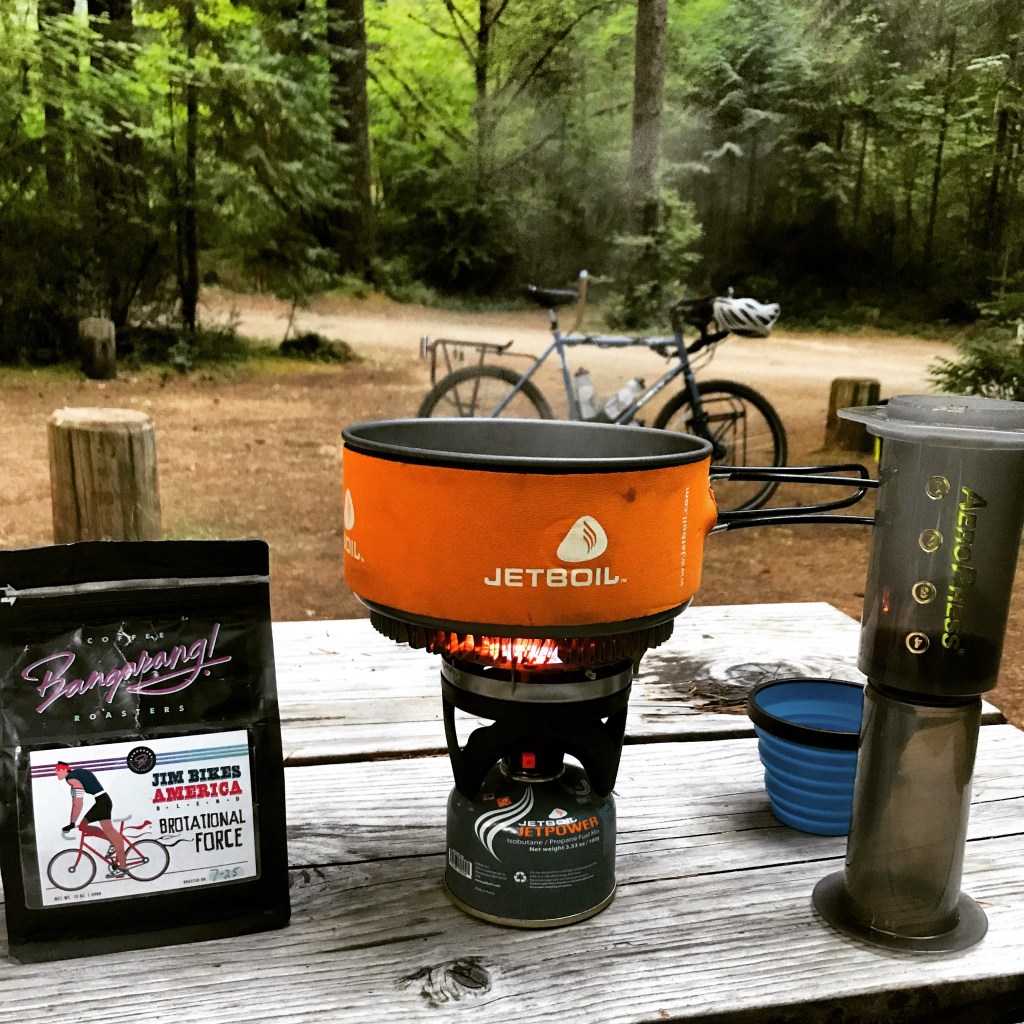
Nothing like a fresh cup of jo to jump start a day of biking. The Aeropress made this easy on my cross country tour.

I’m finishing off the section with a list of gear that I used and/or appreciated the most throughout the trip. Here’s my top five items roughly in order of awesomeness:

1. Aeropress Coffee Maker
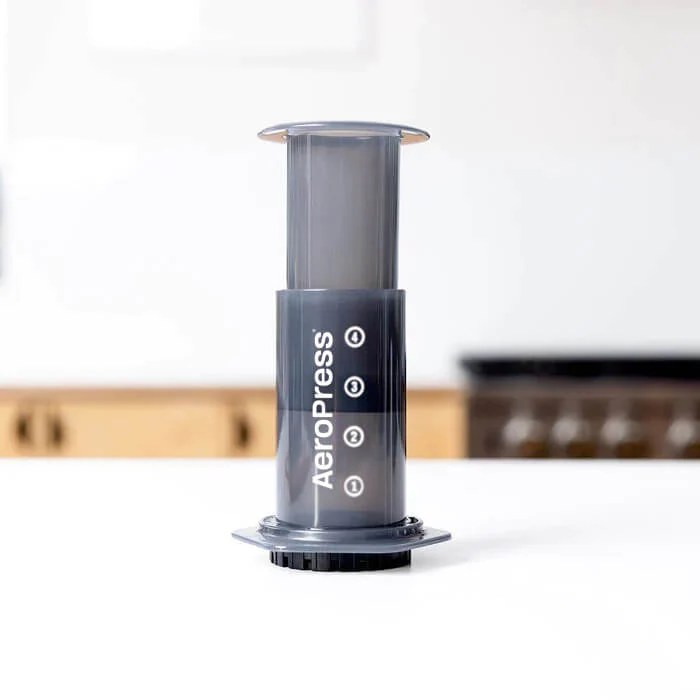
As a coffee lover, there was nothing like having a freshly brewed cup of coffee each and every morning of the trip as a comfort from home. The Aeropress is the perfect bike tour solution for this: it’s portable, unbreakable, easy to clean/use, and makes a great cup of coffee. I used a portable stove to make coffee with it while camping and even used it in the cheap motels I stayed in to avoid the old/musty coffee makers there 😅.

2. Commuter Bike Shoes
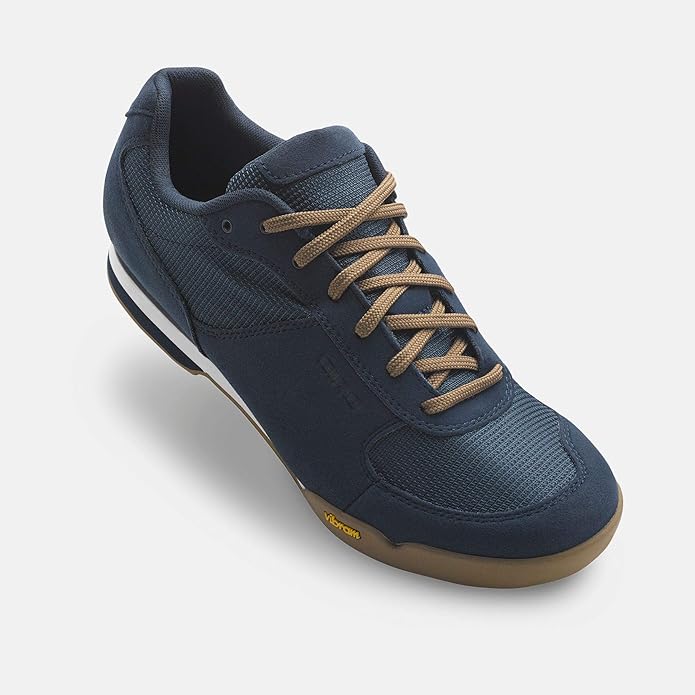
When weight/space is at a premium, multi-use gear is super valuable. I sought out a clipless bike shoe that could double as a casual shoe so I could avoid packing an extra pair. I landed on this commuter shoe by Giro. The cleats worked great on my pedals but didn’t click while I walked, and the shoes were comfortable and looked better than other brands, in my opinion. Highly recommend!

3. Chamoi Butt’r
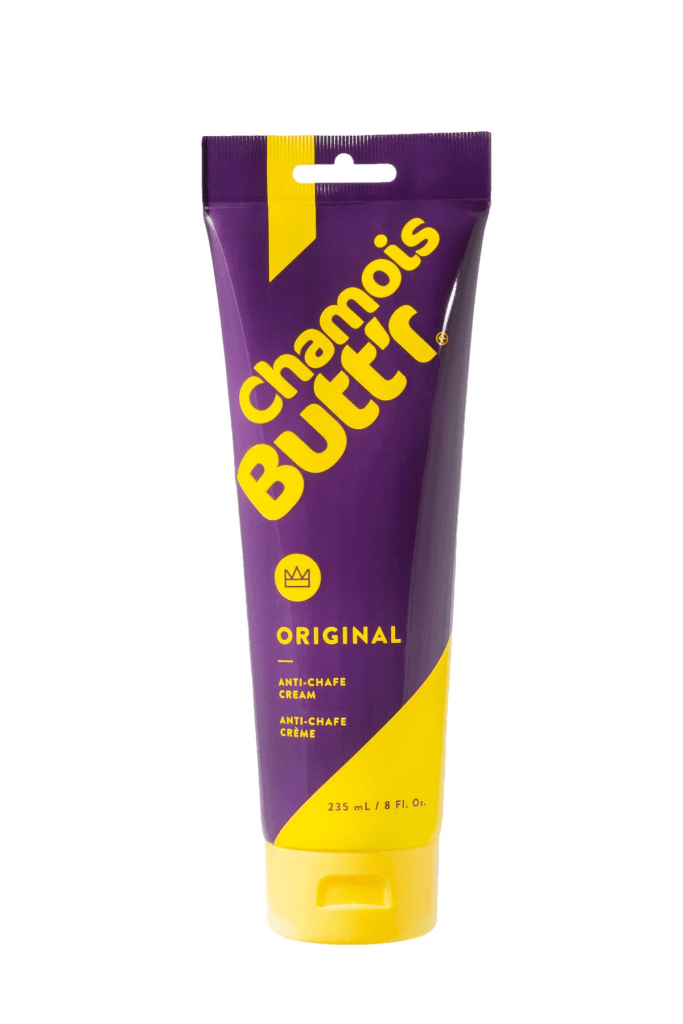
This stuff really saved my butt on the trip! Pun intended 😜. I actually had Chamoi Butt’r recommended by someone the week of my trip as a great anti-chafe cream and did a last minute order before I left. I was so thankful for it. Arguably the hardest part physically to adjusting to biking all day / every day is just sitting on the seat for so long. Chamoi Butt’r made this more bearable and help me avoid saddle sores on the trip. I used it religiously for my entire trip even after my butt got used to long rides on the trip.

4. Ortlieb Bike Bags
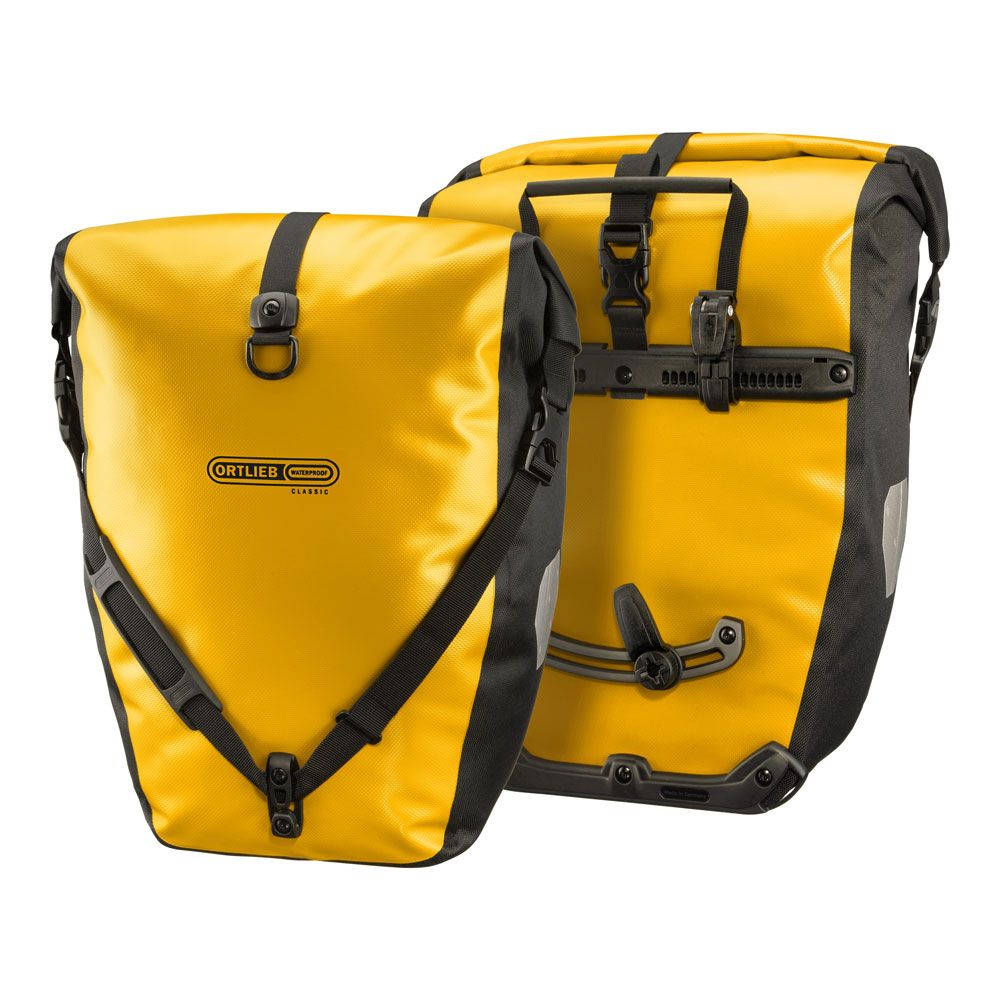
I shouted these out earlier, but the Ortlieb Sport Roller and Back Roller Classic panniers deserve another mention on this list. They do cost more than many competitors, but I opted to purchase these because they were well-reviewed and promised to be waterproof. They didn’t disappoint: I biked through torrential rain a couple times, including the remnants of a tropical storm, and my gear stayed completely dry. Plus, the bags are simple to load and mount/unmount on the bike racks.

5. Microfiber Towel
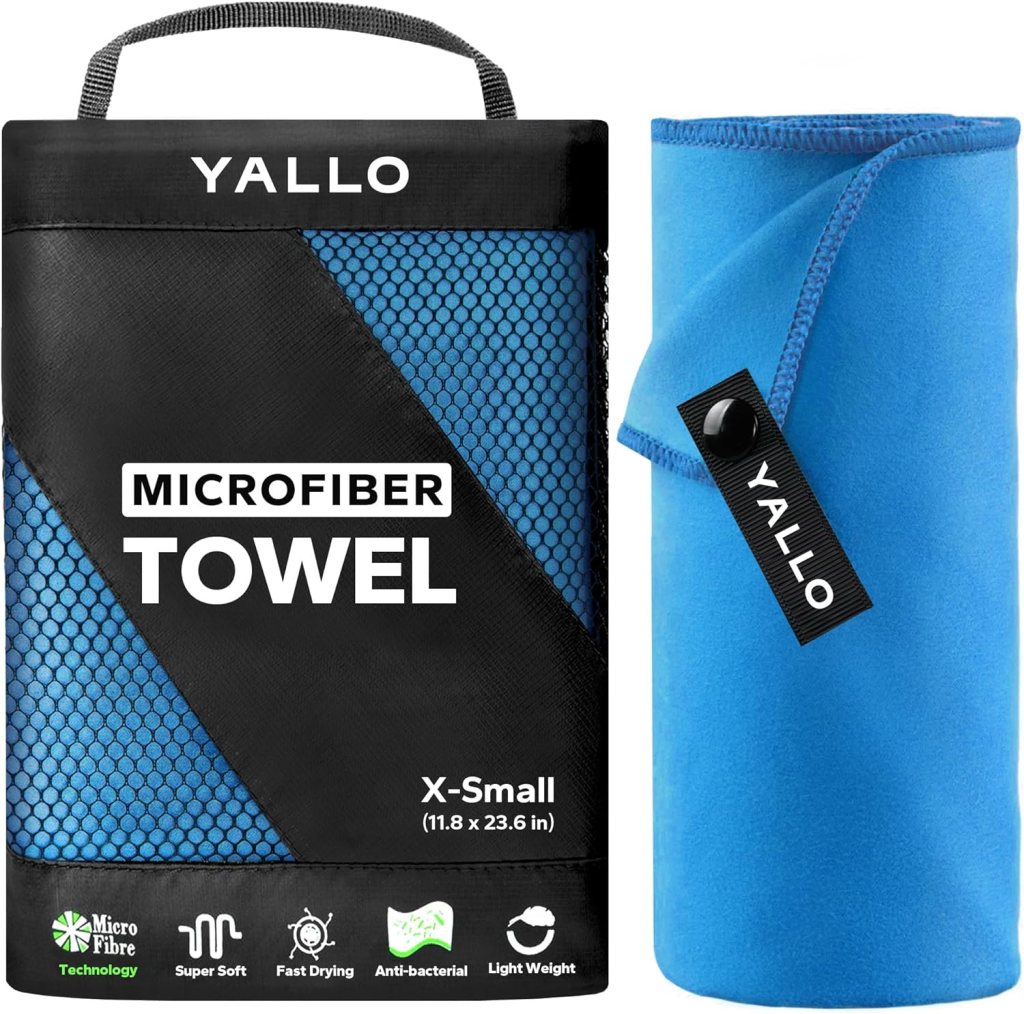
I’m rounding out the list with maybe a bit of a boring item: a microfiber towel. This was another last minute purchase for me that ended up really coming in handy. When you really want to avoid packing a wet towel in your bike bag and you don’t have time to wait around for it to dry, a quality microfiber towel is key. A medium-sized microfiber towel won’t take up a lot of space in your bag but will get you dry and dry itself in a matter of minutes.

On the Road

Now let’s talk about preventing/overcoming the day-to-day challenges of being on the road on a long bike tour. I decided to break this section up by what I thought were the top risks to success for my trip, and the precautions I took daily to prevent them. Click for tips on how to have a healthy, safe, and smooth bike tour.

Concern 1: Bike crash (or getting hit by a car)

Solution: Safety first and foremost – make yourself visible!

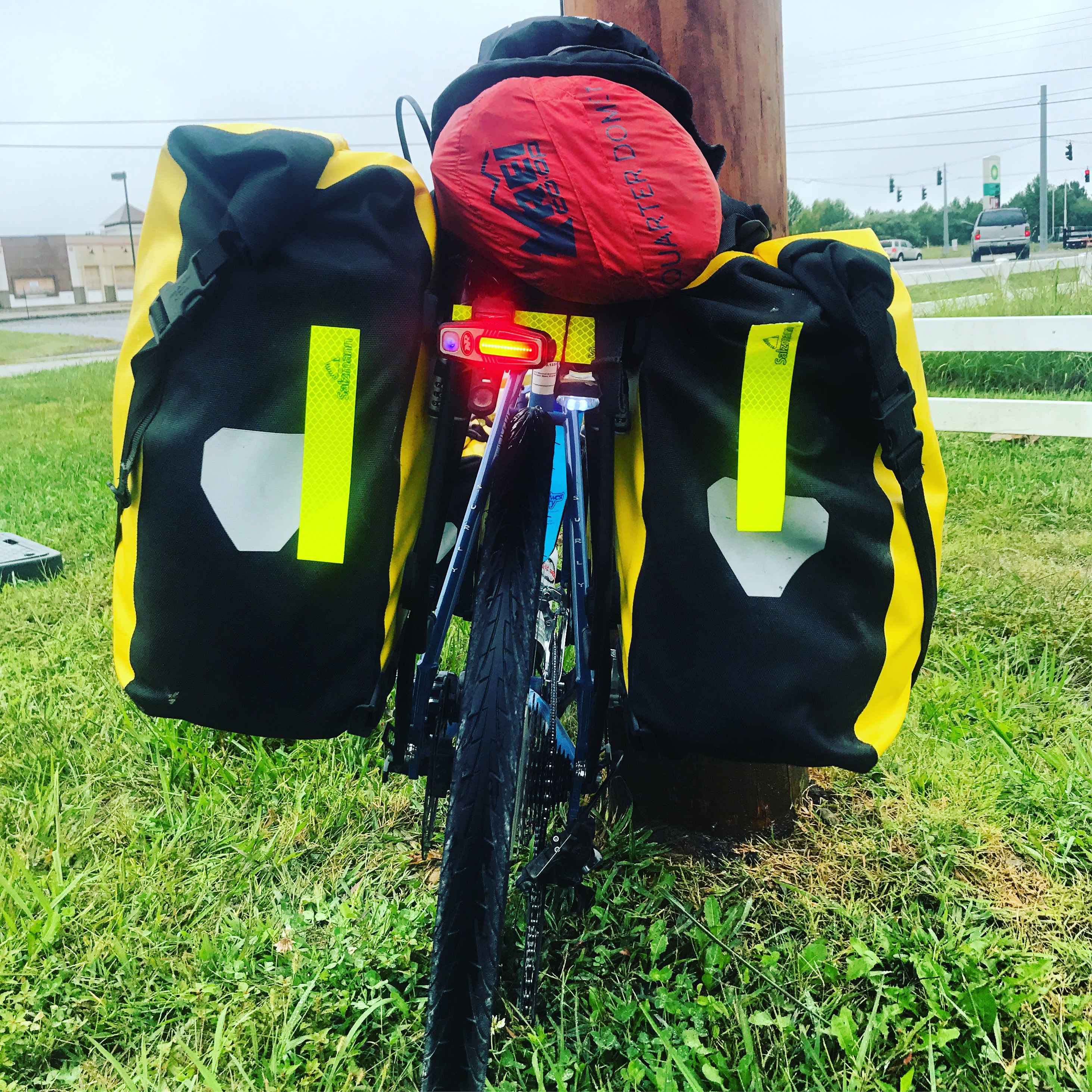
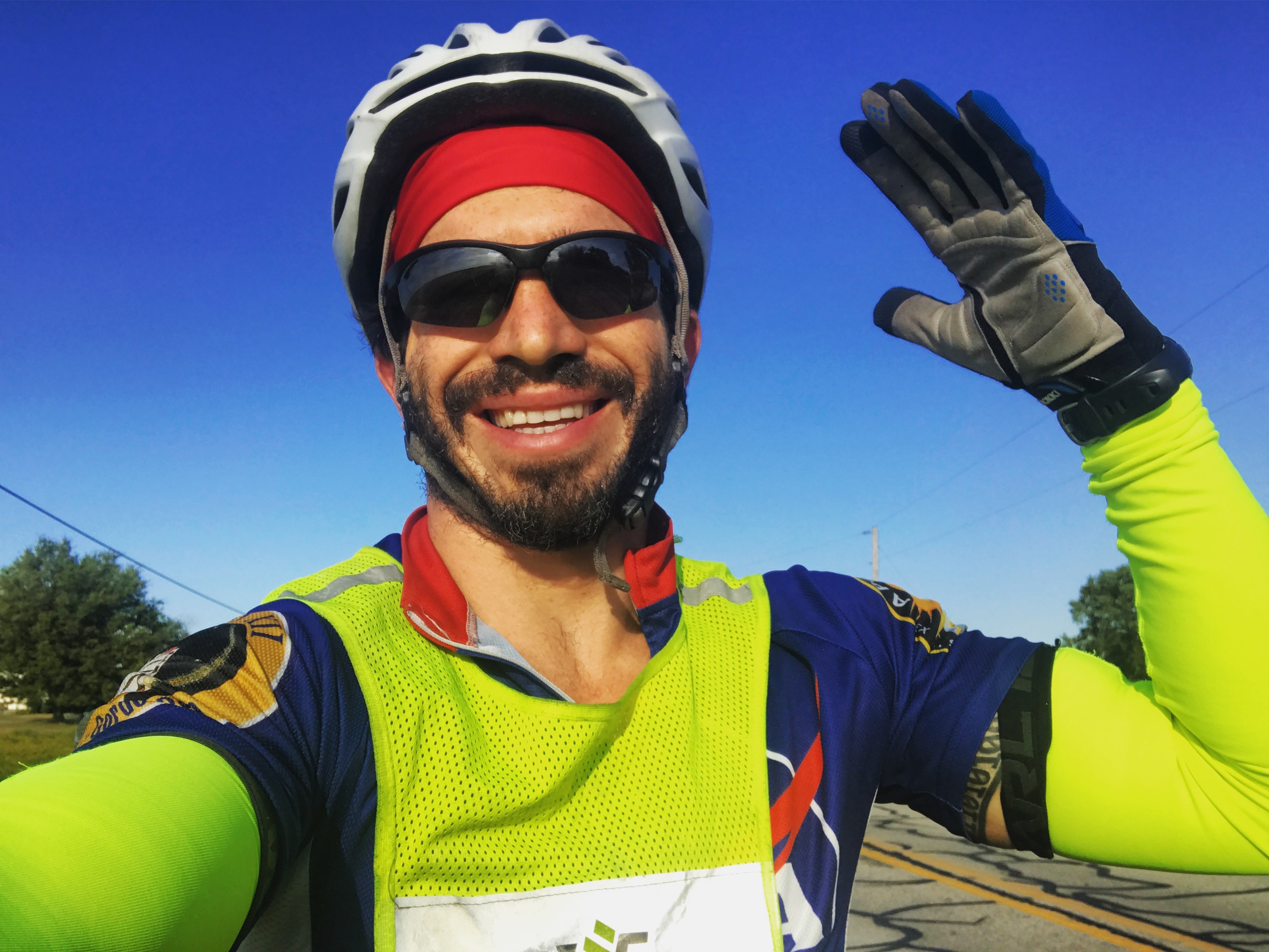
This is obviously the worst case scenario of all concerns that could cut your tour short, so you should be taking any precautions to reduce the risk here. Start by making yourself as visible as possible, especially in high-traffic areas or roads with little to no shoulder. This includes wearing bright colors, a reflective vest, and using lights on your bike/helmet (even during the day). I chose bright colored panniers as well and added reflective strips to them for added visibility. Beyond that, do whatever you can to finish your rides before dark. And finally, choose bike trails and bike friendly routes whenever possible (see route planning).
Concern 2: Bike mechanical failure
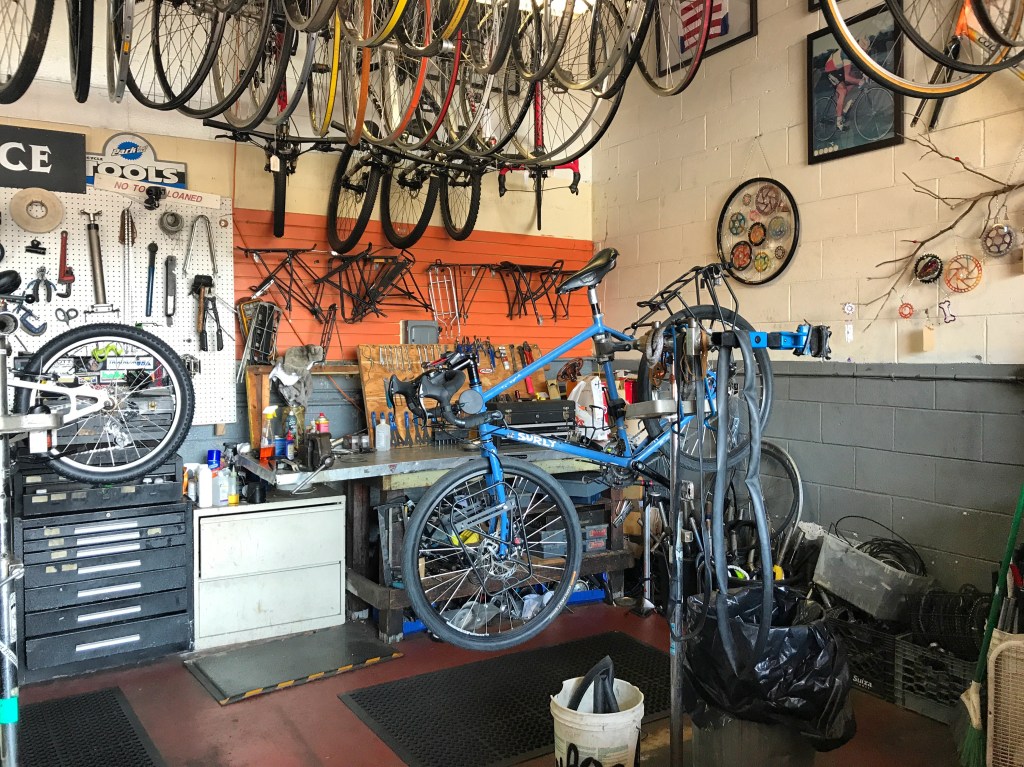
Professional tune up for Frank the Tank in Asheville, NC.

Solution: Perform routine bike maintenance and be prepared for common fixes.

You don’t want to find yourself stranded 40 miles from the nearest civilization with a broken bike. Regular preventative maintenance will go a long way to minimizing the chances of this happening to you. I did “express tuneups” 1-2 times per week or whenever I had a hotel stay (see video below) and got three professional tuneups throughout my cross country trip. Aside from tuneups, I familiarized myself with common repairs – expect to get plenty of practice fixing flats 😉. Always carry a spare tube or two and a patch kit.

Concern 3: Bike theft
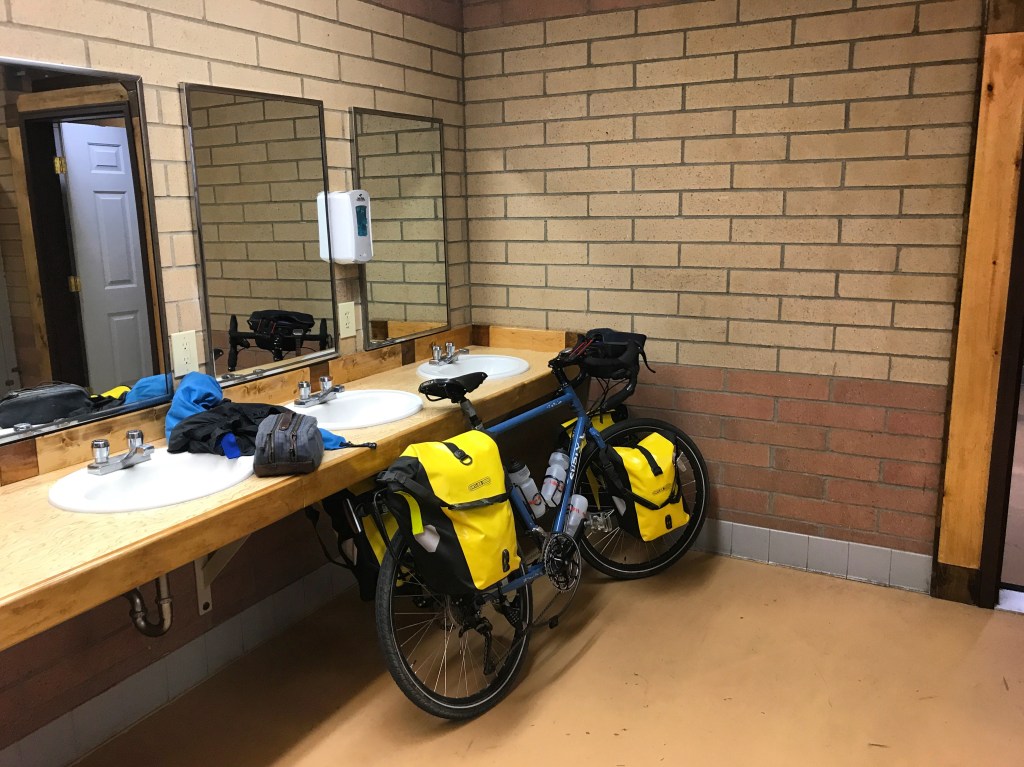
My bike was never far away from where I was throughout my trip… even in the campsite bathroom.

Solution:  Use a quality lock – but make it a goal to never take your eyes off the bike!

I personally viewed bike theft as the most likely thing that could prevent me from making it to the East Coast. I didn’t even like that I had to go in my tent and leave the bike locked up outside a few feet away. Obviously, you can’t take your bike with you everywhere. But do your best to park it strategically so that you can periodically check on it if you do have to temporarily part ways to buy food, etc.

Concern 4: Injury
Stretching my quads in an AirBNB in Jefferson City, MO after along day on the bike.

Solution: Take care of your body with stretching, massage, and rest days.

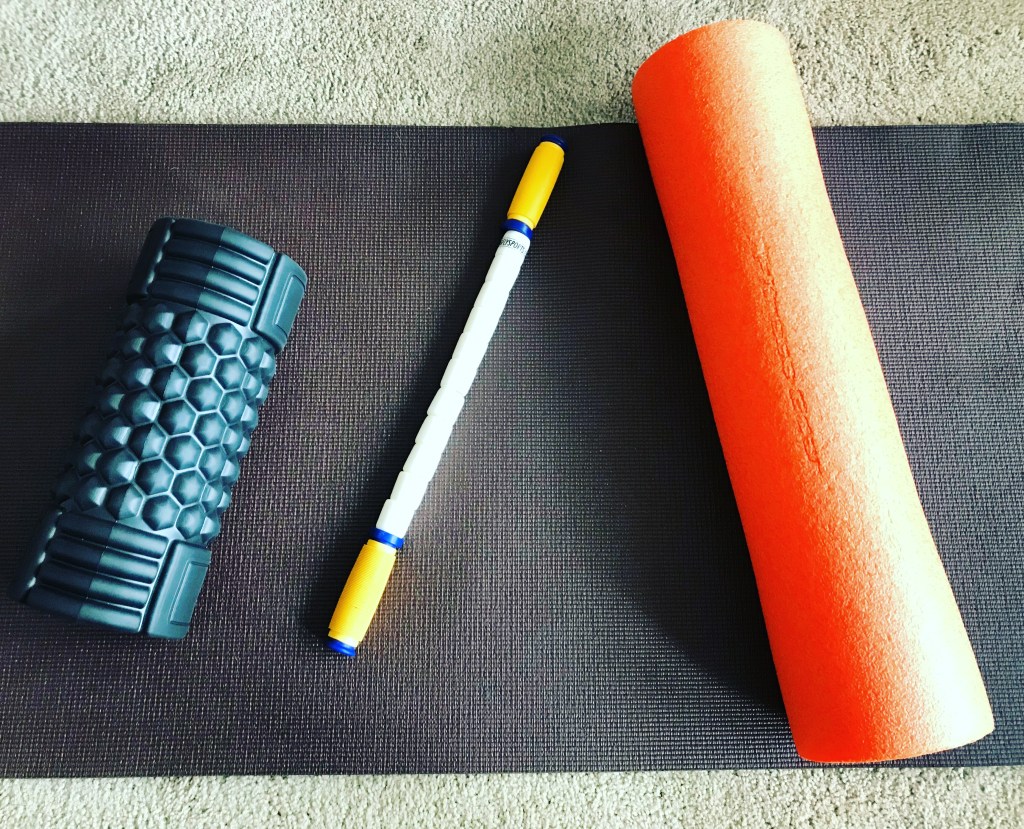
Just like maintenance to prevent bike failure, you should establish a regular recovery routine to help prevent your body breaking down from wear & tear injuries. Aim to get a stretch session in after each day’s ride and, if possible, some self massage (I packed this portable massager on my trip). Try to schedule a rest day at least once per week to allow your body to recover. If financially possible, mix in some indoor stays (hotel, AirBnb, etc.) for a good night’s rest in a (hopefully) comfy bed. Finally, try to do some amount of physical preparation prior to your trip and head into it with a solid base biking mileage.

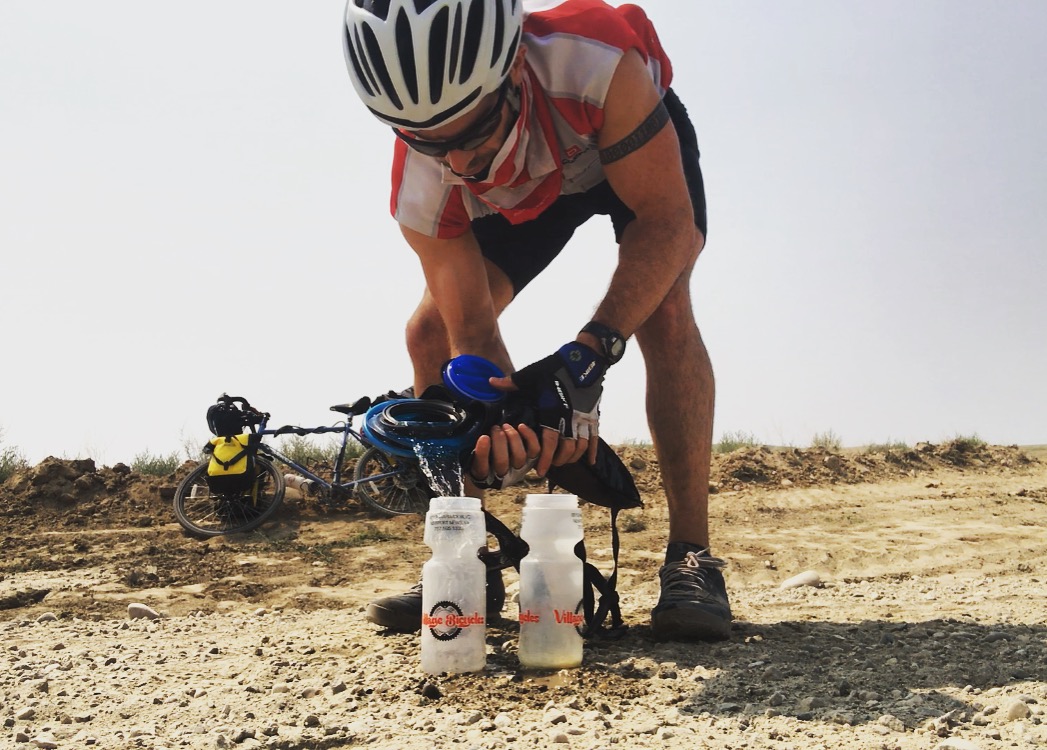
Concern 5: Running out of water

Solution: Plan ahead for long rides – know where you can re-up on water along the way or pack extra water.

For much of the country (especially out West), you can’t bank on passing a gas station every 50 miles on any given route. So having enough water for your ride requires being strategic about water stops when you’re planning the route for the day. This may require adding extra miles to your ride to make sure you pass through towns frequently enough to restock on water.

Even with planning ahead, you’ll likely have days where you’ll ride 50+ miles without a water pitstop. So have pack extra water reserves that you can fill up for long rides. Don’t forget your electrolytes too! I preferred carrying Nuun tablets, but any portable powder/tablet works.

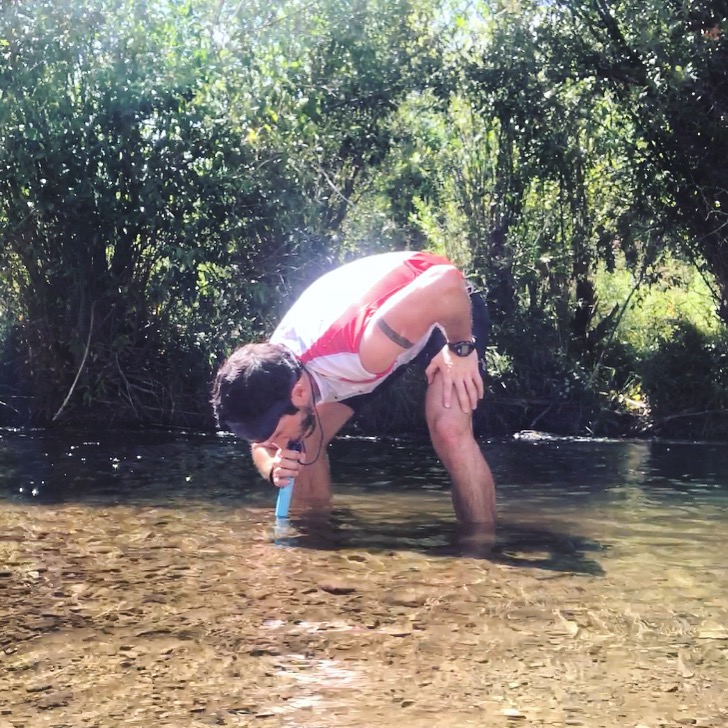
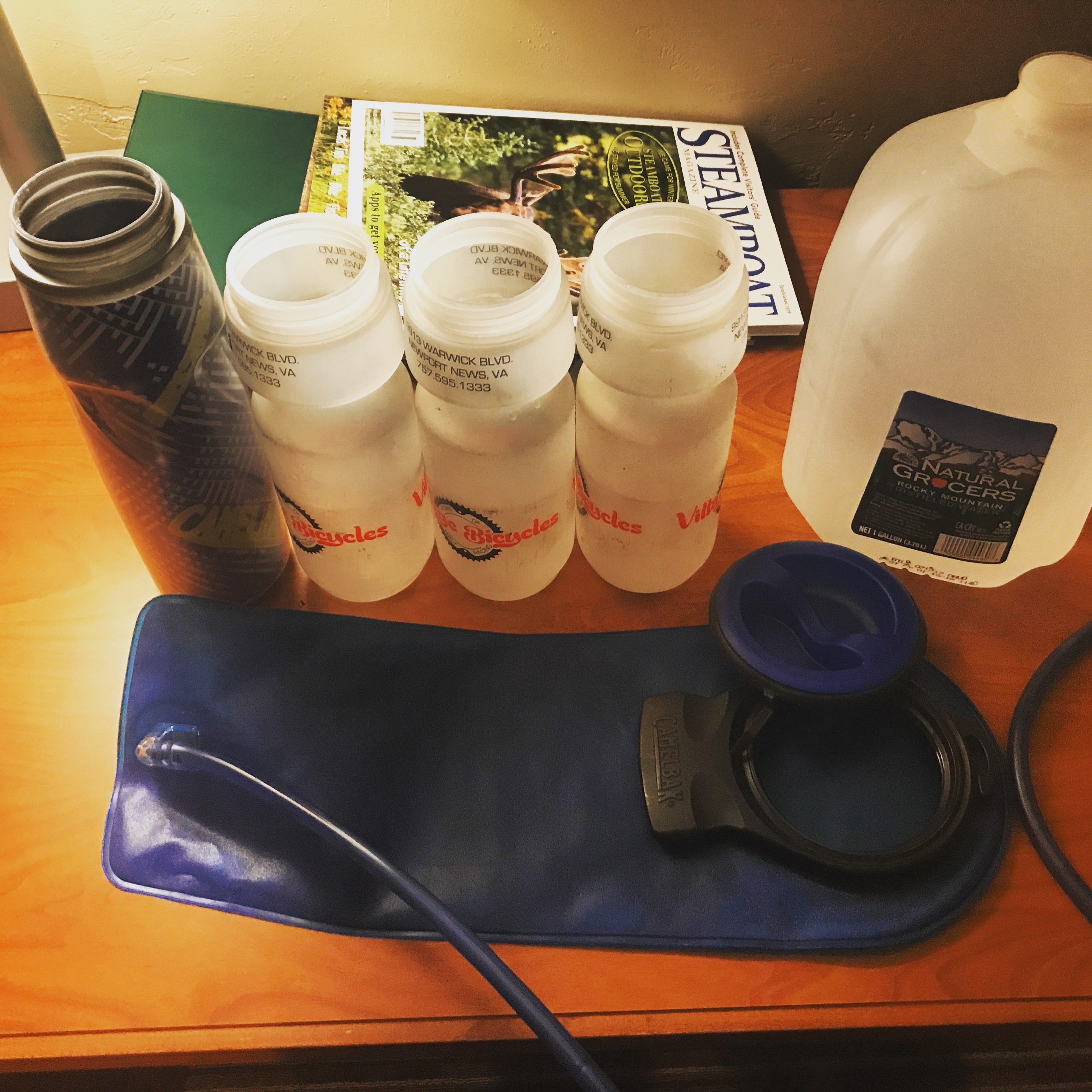
My bike had three water bottle cages but I carried an extra bottle and Camelbak that I kept empty except on long stretches through the middle of nowhere. If all else failed, I also carried a LifeStraw for drinking from a natural source in a pinch.
Concern 6: Running out of charge
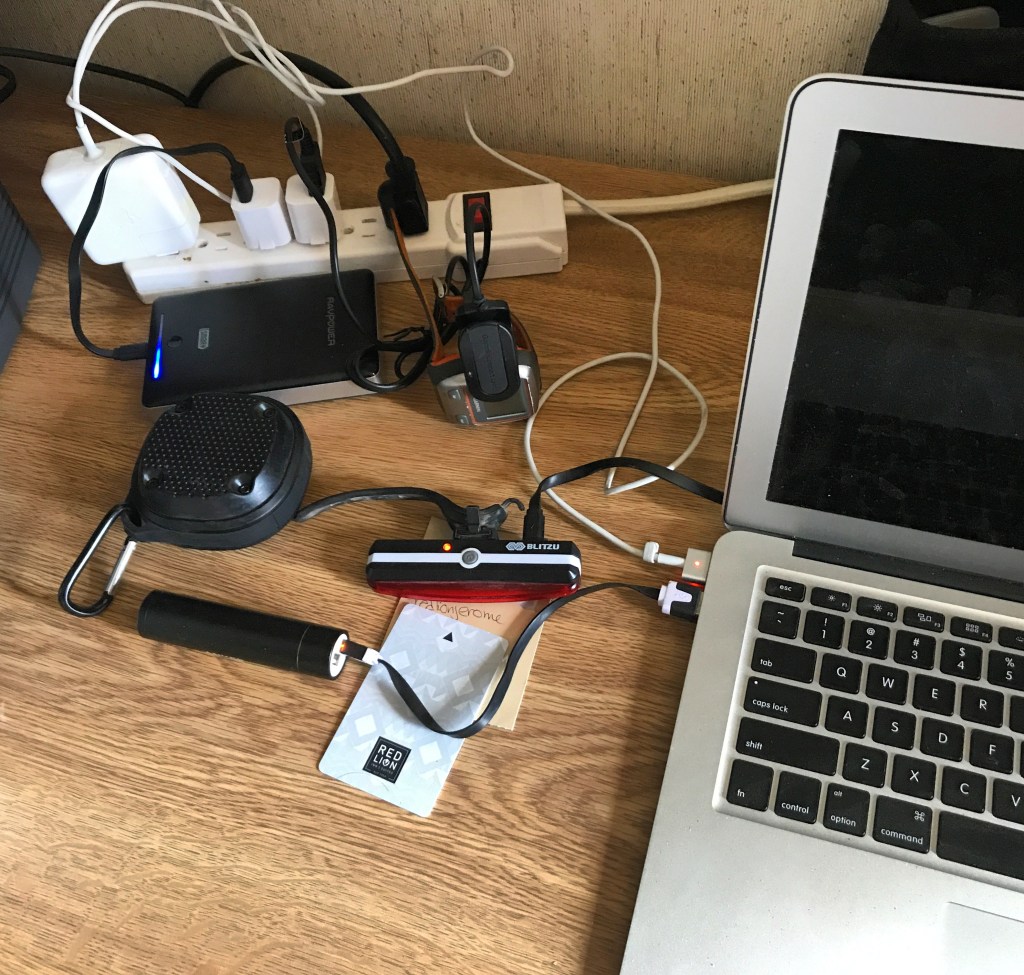
Recharging all of the things during any indoor stay on my trip.

Solution: Carry a portable charger and recharge whenever possible.

You’ll want to make it a goal to never let your phone die in case of emergency. This gets more challenging if you’re taxing your phone’s battery with navigation, playing podcasts/music, etc. all day and if you’re camping at night without access to electricity.

Pack a portable charging block or two for your trip. I kept my phone hooked up to a smaller charger in my handlebar bag and had a larger charger in my panniers for backup. Make it a routine to recharge all electronics (phone, portable chargers, bike lights, etc.) whenever you have access to electricity overnight. If you’re planning to mostly camp at night, you can also buy a portable solar panel so you can charge while you ride.

FAQ

To finish up this guide, I’m providing my answers to some Frequently Asked Questions about cross country bike touring that I’ve either been asked by others since my trip or that I had myself for others before I left for my trip.

How often did you camp vs. hotel vs. Airbnb vs. other?

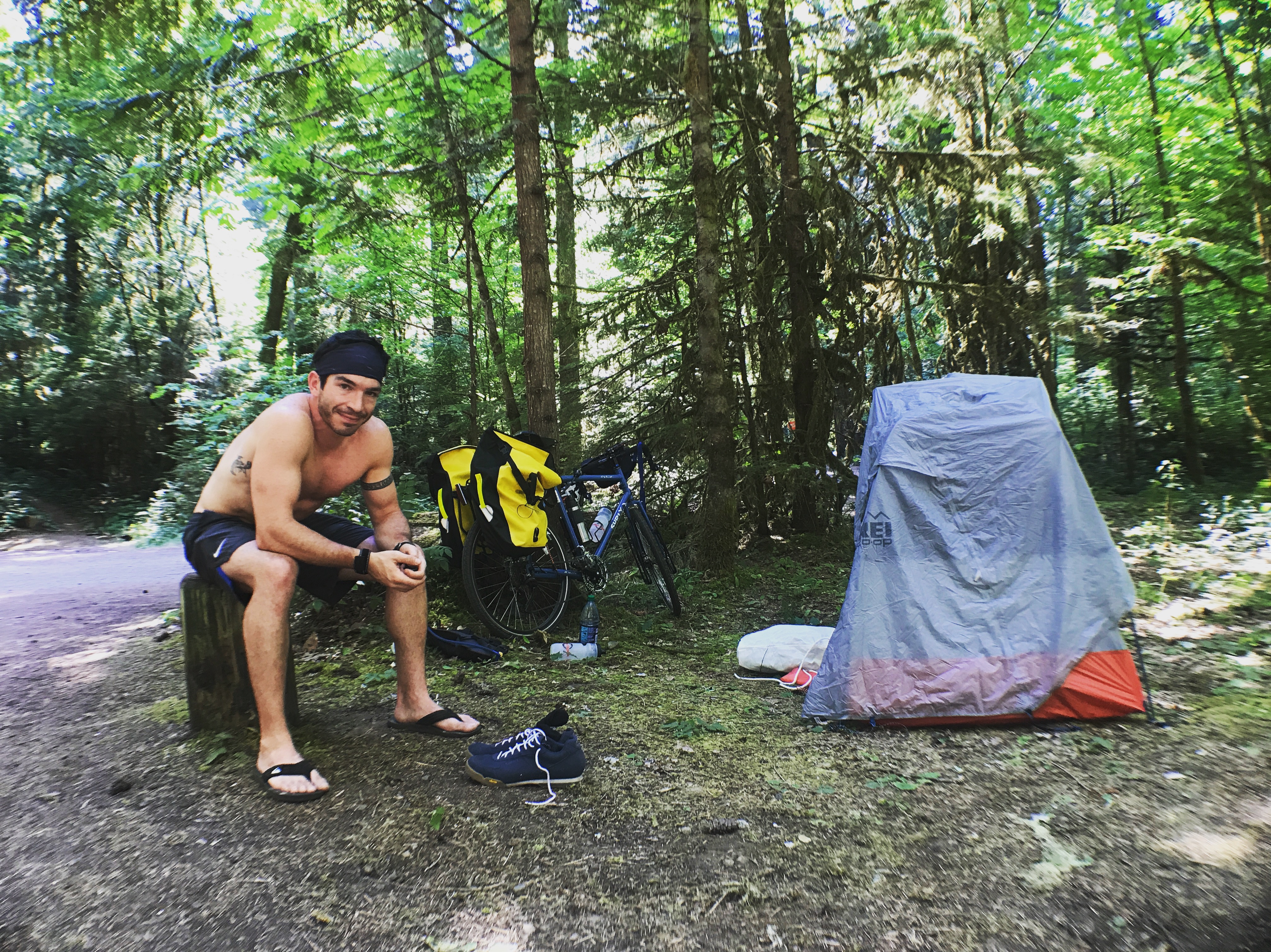
The type of accommodations used throughout a bike tour comes down to a balance of saving money and taking care of your mind/body. You’ll save a ton of money if you opt to camp every night, but splurging on indoor accommodations with electricity, shower access, a bed to sleep in, etc. can leave you feeling more physically/mentally rejuvenated for powering through your next day’s ride. Ultimately it will come down to your budget and your love (or tolerance) of the great outdoors.

I camped roughly 1 out of 3 nights over the course of my trip, only camping back-to-back nights twice. I personally found it pretty tough to repeatedly bike 6-10 hours per day followed by sleeping on the ground in the tent. Plus, I was fortunate to have saved up enough PTO at work that I was still getting paychecks on the road, affording me the ability to splurge a bit on extra comfort.

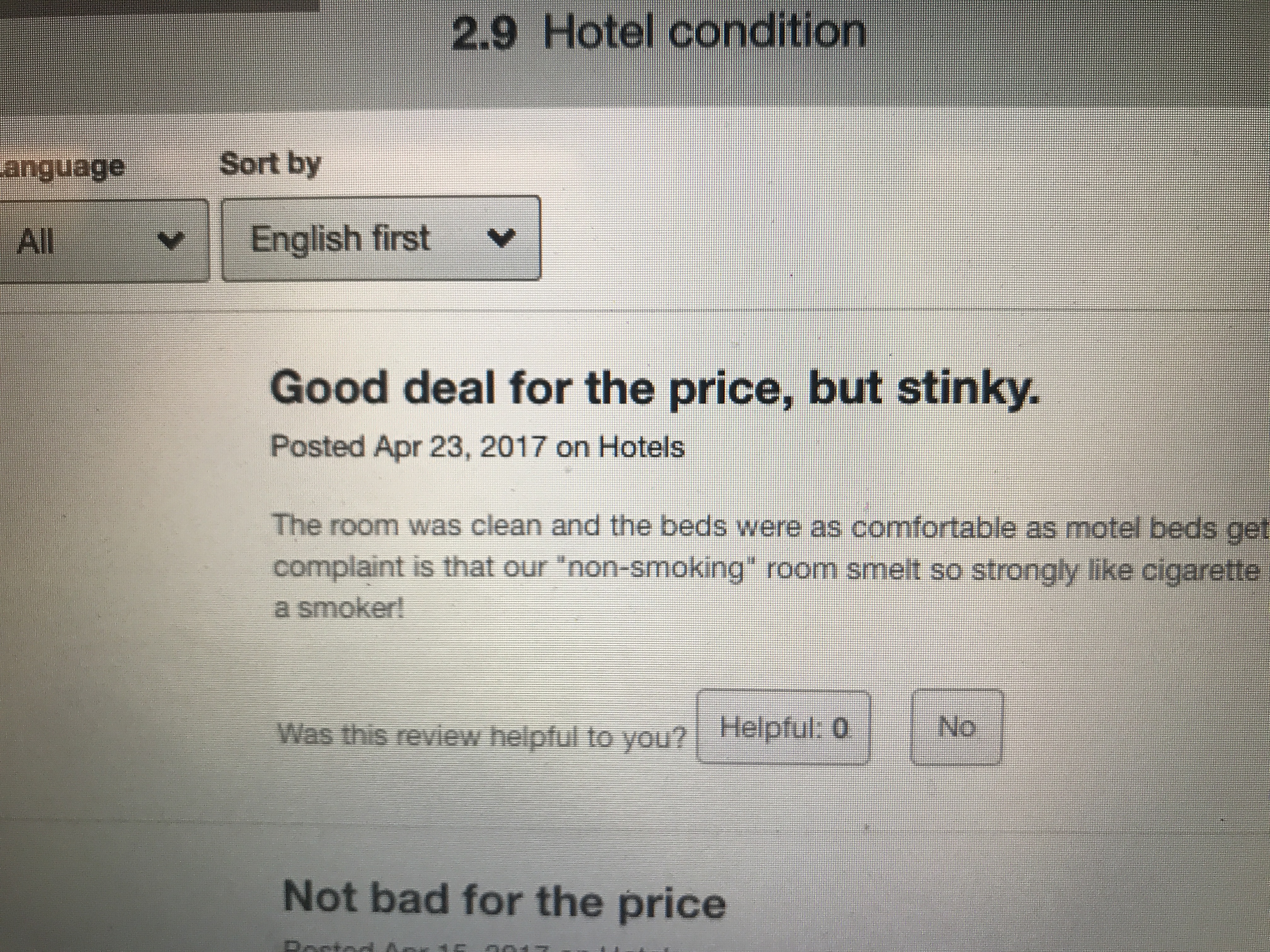
I ended up trying most types of accommodations on my trip: camping, hotels (from decently nice to down right dirty), Airbnb, WarmShowers, and staying with friends (of friends). My personal favorites for balancing cost/comfort were RV parks for camping with extra amenities and AirBnb single rooms as relatively cheap indoor stays.
How do you bike through the Rockies with all that gear!?
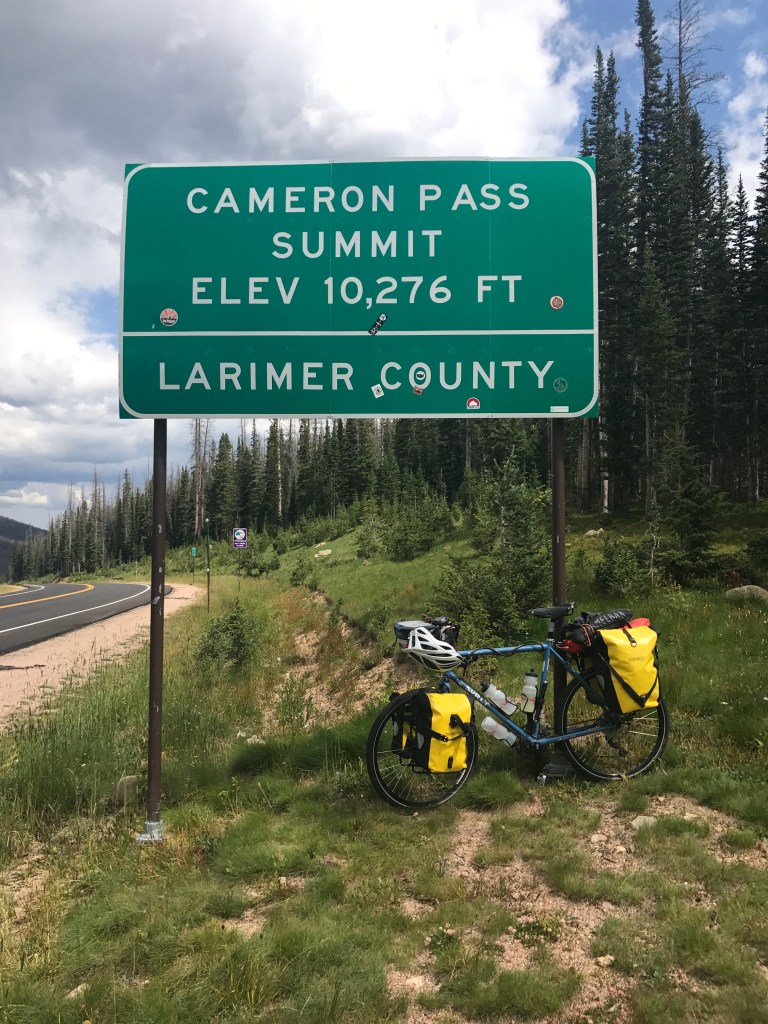
Peak elevation for my cross country trip: 10,276ft at Cameron Pass.

This was one of my biggest questions/concerns heading into my trip. Back then, I had never driven through or visited the Rocky Mountains, only viewing them from a distance when visiting Denver. So I think I let my imagination run wild with how intense that part of the ride may be (20% gradients, blizzards in the summer, etc. 😅).

Now, I can only speak to my particular route through Colorado (Steamboat Springs -> Walden -> Fort Collins), but biking through the Rockies wasn’t as challenging as I thought it would be. This also echos what I heard from a couple experienced cyclists when I asked them prior to my trip. The hardest climbs through the Rockies were comparable to some in other parts of the country along my route. The increase in elevation was slow and steady coming from the West, giving me a chance to adjust to it over the course of a few days before hitting the summit on my route. Plus, if you’re doing a cross country trip, you should be in pretty good shape by the time you get there.

There’s also plenty of reasons to look forward to crossing the Rockies rather than fear them: it is arguably the coolest and most memorable part of the trip! The scenery is unmatched and the sense of accomplishment from powering on a bike is unforgettable. Just make sure you’re avoiding months where there’s likely to be snow, and enjoy the ride 😎.
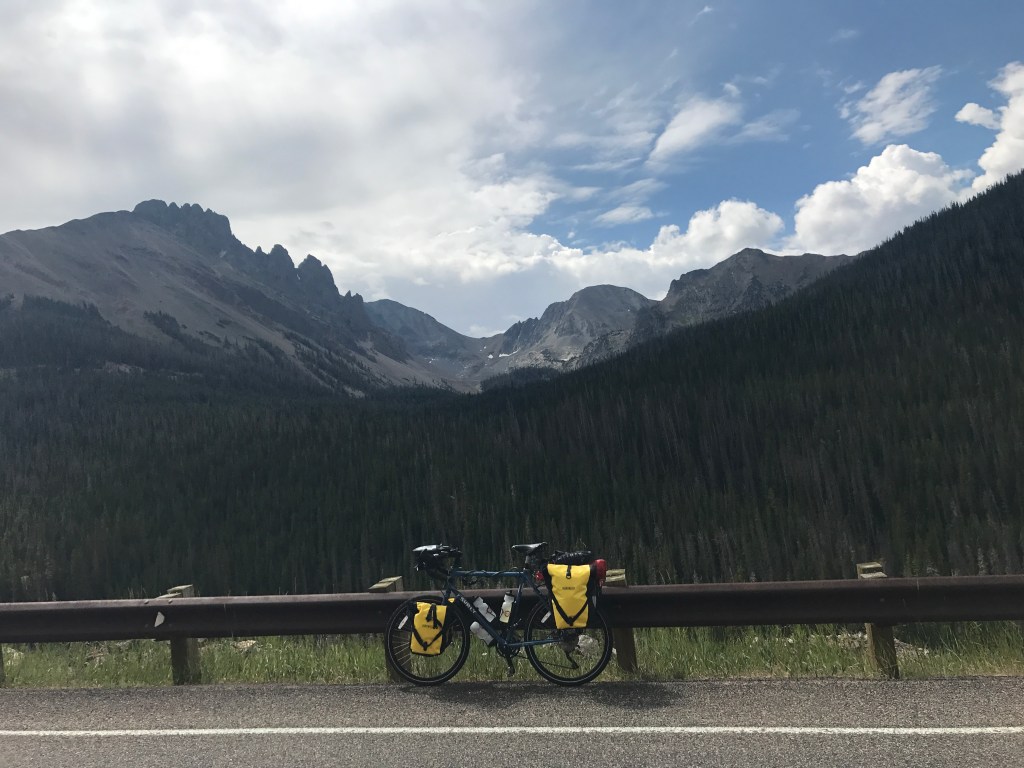
Biking through the Rockies is arguable the coolest and most scenic parts of a cross country trip.

How much physical training is required to embark on a long term bike tour?
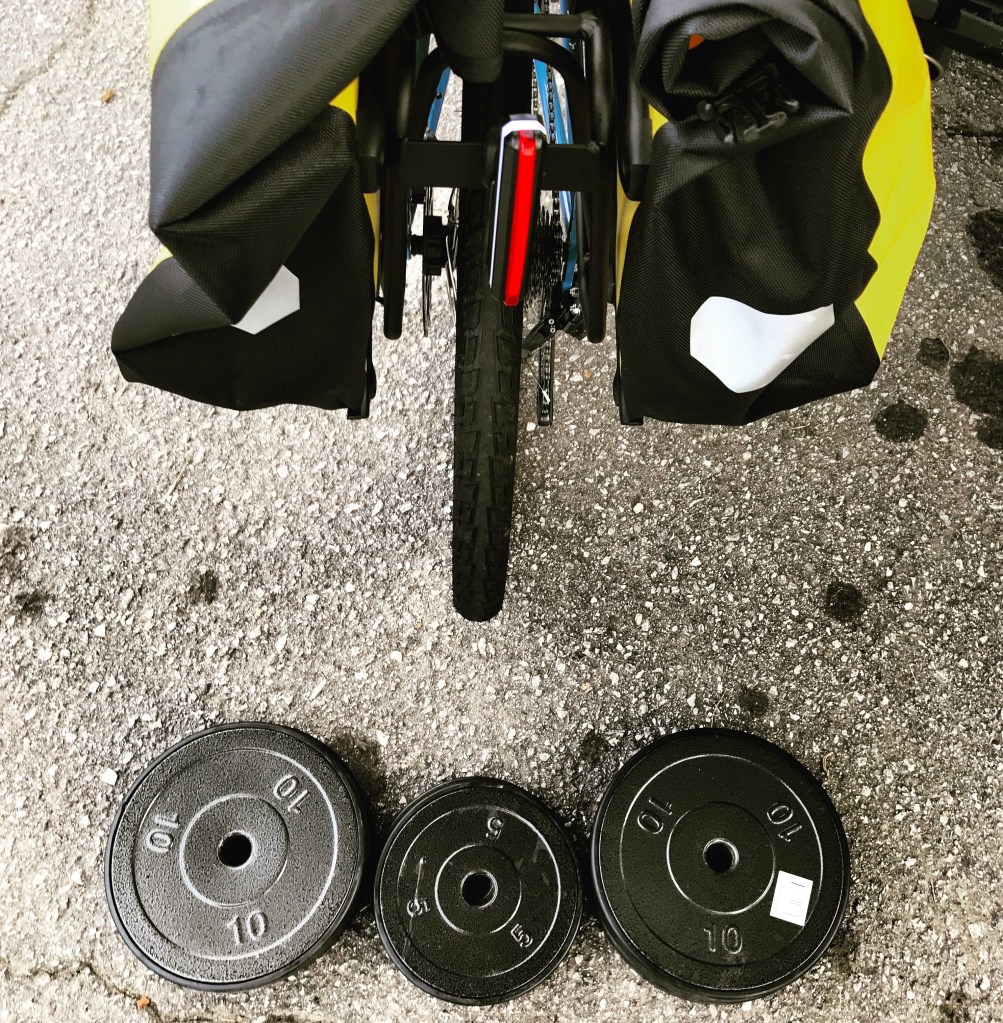
Before my trip, I tested out biking with different amounts of weight to get a feel how much gear I could reasonably carry.

I was definitely in good shape heading into my trip, working out daily and biking 3-4 days per week. Having said that, I think it’s easy to overestimate how much physical training you need. I felt that the main challenges were mental (am I there yet?) and logistics (see route planning section above). You’ll get in good biking shape on the fly as you go, just plan on having a sore butt/neck/legs/etc. for a week or two and try to plan low-to-moderate mileage days in the beginning of the trip to ease in.

Having said that, I recommend biking enough in the weeks and months leading up to the trip to be comfortable sitting on the bike for extended periods of time. It’s a good idea to do at least a few long bike rides with your gear loaded (or weights to simulate it) to get used to hauling the weight (or convince yourself to carry less gear 😝). I told myself I’d try at least a 1-2 night mini tour to prepare for my cross country trip but I never got around to it. While I lived to tell about it, doing a test run like this would certainly be helpful.

How much clothes did you pack?

With space at a premium, you’ll want to pack as little clothes as you can while being conscious of your comfort (and tolerance for being smelly). I valued having the little extra comfort of a clean/dry outfit at the end of a long day biking, so I may have packed a bit more than the average bike tourist. Here’s the complete list of clothing items that I packed for my cross country trip:

  • Three bike jerseys
  • Three pairs bike shorts
  • One pair athletic shorts
  • One pair casual shorts
  • Three casual shirts, one tank top
  • Three pairs underwear
  • Three pairs of socks
  • One pair bike shoes (that doubled as casual shoes)
  • Flip flops
  • Cold/rain gear: spandex pants, rain coat, hoodie, arm sleeves

What were the biggest surprises?

I was surprised by a lot of things on my trip! Here’s a short list:
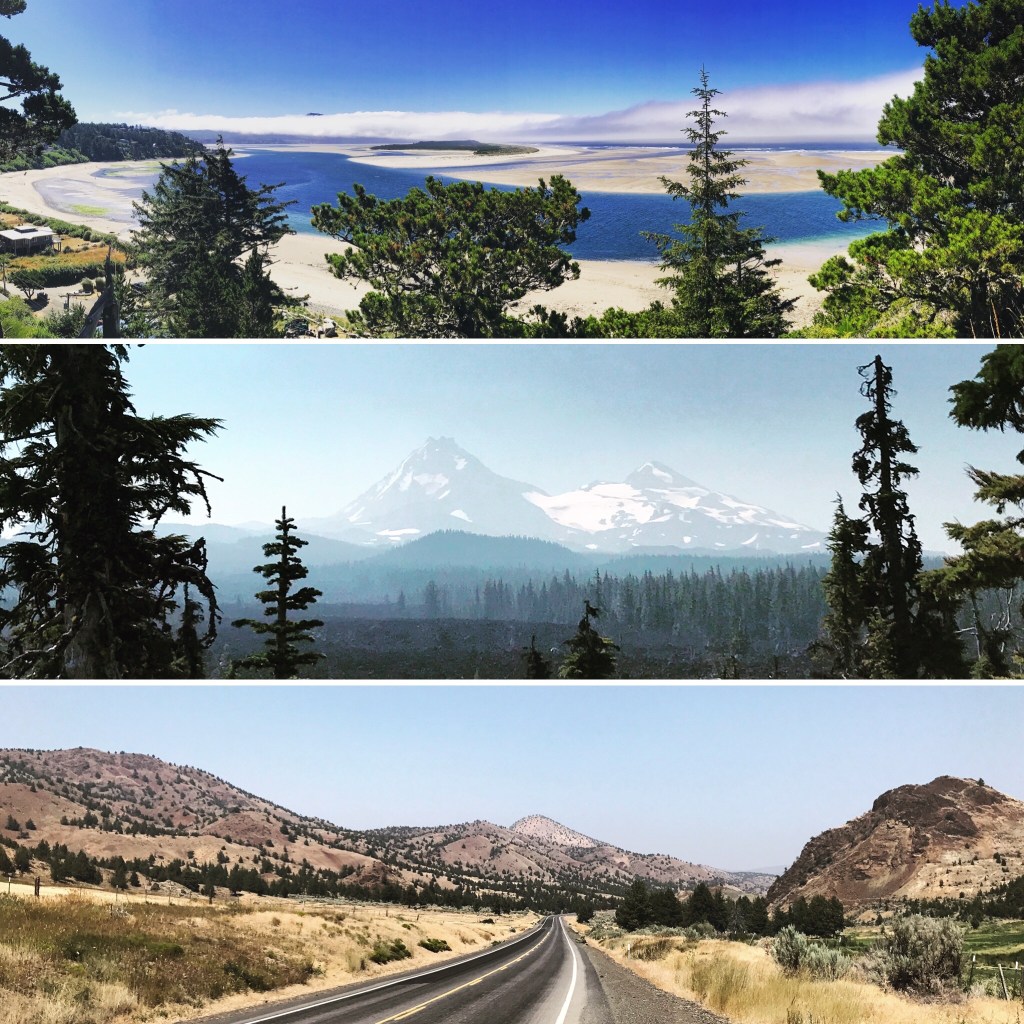
Scenic Oregon: coastline, mountains, desert.
  • Lack of civilization out West. While I expected this to some degree, I totally underestimated it. I’d often go an hour or two without having traffic pass me by (which was nice) and learned quick that you might go 100 miles without passing through a populated town without proper planning (which, as I mentioned earlier, made route planning surprisingly hard also).
  • There’s desert in Oregon!?” – me on day four of my trip 😅. The amount of desert in the Northwest, US was definitely surprising to me. I expected to ride through desert landscape in Utah, but I admit that I was caught off guard when most of my ride through Oregon and Idaho was also desert.
  • The not-so-intimidating Rockies. I already mentioned this above in FAQ, but as I kept slowly and steadily ascending the mountain range, I kept waiting for the crazy/impossible climb that never happened.
  • People’s willingness to help a crazy stranger on a bike. The pleasant surprise of the trip was the outpouring of support and encouragement I received throughout my trip, from both friends/family/acquaintances, but also from total strangers. Several times on my trip, friends of friends who I’d never met welcomed me into their houses to stay the night, let me shower, cooked me dinner, etc. Dozens of strangers opened up their wallets and supported a fundraiser I was running for the Boys & Girls Clubs throughout my trip. The interactions I had with super friendly and encouraging people along the way who I’d never see again in my life was one of the coolest parts of the journey.

Closing

Hopefully if you’re a new/aspiring cross country cyclist and you’ve stumbled across this post, it has been helpful for you. And since this ended up being a much longer read than I intended, thanks for sticking around until the end! If you have any other questions for me on anything I didn’t cover, I’m happy to chat: email me at jimwarnerendurance@gmail.com.

Now what are you waiting for – commit to your trip!

Acknowledgements

This blog post is an accumulation of the lessons I learned by going through the planning/research process and bike tour experience myself. But I also learned a lot from others who deserve an acknowledgement since their second-hand guidance and tips have appeared in this post.

I sent many of the pre-trip questions I had to anyone I could find who had done bike tours before, and got useful pointers from people like: Pierre Rouzier, Aaron Daytime, Ally Bolger, and Mike Matthews. Mike deserves a big shout here: he was the only friend I had who had biked across the country before which served as inspiration in itself. He also sent me a long and detailed email a couple months before my trip with a lot of helpful pointers from his experience, and helped give me the confidence I could do it myself.

Walt and Connie at Village Bicycles were super helpful in getting the gear I needed for the trip (including the bike!) and making me feel at home with my crazy plans to set off across the country with no previous touring experience. Highly recommend their shop to anyone local to Newport News, VA.

Finally, Patrick “Mission Control” Leser was the good friend/colleague of mine behind my advice to “Ask a friend/family member to help you do route recon” earlier in this post. He was instrumental in helping me find safe routes and freeing up some extra time for me to just enjoy the trip. We learned bike touring on the fly together.
Take Your Training to the Next Level … Do the Boring Stuff

Seven tips to work smarter, not just harder, towards your endurance goals

Many aspiring endurance athletes are frustrated by a lack of progress and the inevitable plateaus in fitness. Many are in a PR drought despite record mileage and working as hard as ever in their workouts.

Well here’s the thing: unlocking your true potential as an endurance athlete requires thinking beyond just high intensity & mileage and the physical side of training. It’s not all about the flashy workouts posted to social media. It’s about the work you put in when no one’s watching. It’s the “boring” stuff you do behind the scenes that will take your training to the next level.

In this post, we’ll talk about seven points of emphasis for endurance training that are, for the most part, easier physically but can be harder mentally. They often require focus, discipline, and patience. They’re probably not going to impress your followers on Strava. But it’s these things that are going to separate yourself from the competition at your next race.

1) Revamp Your Diet & Fueling

Meal Prep Sunday!

This one’s arguably most important but the toughest to dial in on. We all know that the food you consume is your fuel for training. So if your training is stuck in a rut, take a look at your diet. Log your food for a few days and see how it shakes out. Changing your diet takes a ton of will power, so focus on making small, incremental improvements. Talk to a registered dietitian if you need more help.

Carefully consider what you’re eating before, during, and after workouts and races. This is especially important if you’re training for longer races and triathlons. You need electrolytes & calories (mainly carbs) for longer efforts, and the specific amounts vary a lot from athlete to athlete, requiring some trial and error. Training is when you need to do this experimentation to iron out your race day game plan.

2) Emphasize Recovery

Training = Work + Recovery

Why do we tend to focus so much on the hard stuff (the work) and neglect the easy stuff (the recovery) in training? It’s easy to feel like we aren’t making progress when we are resting, but recovery is the part of training when we get stronger! Plus in a sport like running with such a high injury rate (nearly half of us annually!), recovery is our best defense from being sidelined.

A few tips: get more sleep (strive for 8 hours!), revamp your post-run recovery routine, incorporate weekly rest and/or active recovery days to your training schedule, include foam rolling, stretching, and yoga with your weekly exercise, and keep an eye out for symptoms of overtraining where you may need to reduce your intensity/mileage.

3) Don’t Skip Your Warmup & Cooldown

I’ve written about the importance of warming up and shared tips to prepping your body for movement and training. Cooling down is just as important and goes a long way towards jump starting the recovery process so you’re recharged for your next workout.

I know we are all pressed for time and warmup and cooldown are often on the chopping block when we’re in a hurry. A pro tip is to start officially scheduling them in your daily workouts; ideally aiming for 10 minutes for each. Log them on your watch & fitness accounts to “get credit” for them, making it more rewarding. Your performance will benefit because of it.

4) Slow Down!

I know, I know – running slower is the epitome of boring stuff. But I’m willing to bet that this is the one that most people need to hear, especially if they don’t already have a coach to preach it to them. So…

You should be spending a large majority of your training at low intensities!

The common rule of thumb is that you should adopt an 80% / 20% split between low and high intensities. While it seems counterintuitive to train slow in order to race fast, low-intensity efforts are key to boost your aerobic system and power you through all race distances from 5K and beyond. Check out this book if you need more convincing.

How slow is slow enough? Stick to paces that are conversational for your low intensity workouts – you should be able to comfortably speak in sentences. Or better yet, guide your intensity using heart rate.

5) Improve Form & Technique

A key way to work smarter in training is to use your workouts to become more efficient in addition to more fit. This means taking time to focus on form.

The best time to make changes to form and technique is in the offseason when you’re in between training cycles. Otherwise, you’re more likely to fall back into your same habits if you feel rushed and pressured to build speed and endurance for an upcoming race.

Overstriding vs. a health stride

So what are a few key things to focus on? Most importantly, learn rhythmic breathing if you haven’t already done so. Beyond that, you can focus on increasing your cadence and improving running posture. Triathletes can work on bike skills, including increasing cadence and improving pedal strokes, and swimming drills. Improving technique is not easy to do on your own, so consider reaching out to a coach for help.

6) Incorporate Cross Training

The best way to get better at running is, well, to do more running. For most runners though, it’s crucial to set aside a couple days per week for low impact, cross training workouts as a break from the wear & tear and pounding from running. And all runners and endurance athletes can benefit greatly from strength training. While triathlons force you to balance your training, runners need to have the foresight and discipline to do this.

Extreme planking! See this blog post for (less extreme) core exercises to do at home and at the gym

In addition to non-running cardio exercise like rowing and biking, I’m a huge proponent of adding strength training and yoga into the weekly routine. Strength training, targeting lower body and core in particular, is important both for injury prevention during training and staying strong & maintaining form deep into races. Yoga can improve your balance, mobility, and breathing. See the video above for a quick healthy hips strength routine; or this video for some fun balance exercises.

7) Work Out with a Purpose (Follow a Program)

Having a specific purpose for each workout is what separates training from just working out. Now there’s absolutely nothing wrong with recreational exercise to get in shape and stay healthy. But if your ultimate goal is to perform at a high level in a race, then you should have specific daily goals that guide every workout.

So: what was the purpose of your run today?

Was it to build aerobic endurance? To increase your V02max? To hone in on a race pace? To facilitate recovery?

A sample training program that I craft for my clients – email me to ask about getting one of your own!

The best way to always know the answer to this question throughout training is to follow a solid program. And the best way to create a program that works for you is to find a qualified coach. A coach can educate you about the purpose of your weekly runs and provide a plan that is tailored to your experience and goals.

Wrap Up

To be honest – I trained a lot harder physically when I was younger and in my “prime” years. I had a no-pain / no-gain mindset in my workouts and put relatively little thought into recovery, diet, form, etc. I put up some decent race performances but often paid for it with injuries.

These days, I focus much more on the working smarter and embracing a more holistic approach to endurance training with the pointers above. While I continue to get farther from those “prime” years, I also continue to avoid injuries and PR different race distances. I’m performing better than ever. The difference: the boring stuff. I hope reading about them helps you take your training to the next level too!

The 2021 Virginia 24 Hour Run for Cancer: Race Preparation

Keys that Set Up Success for My Second Attempt

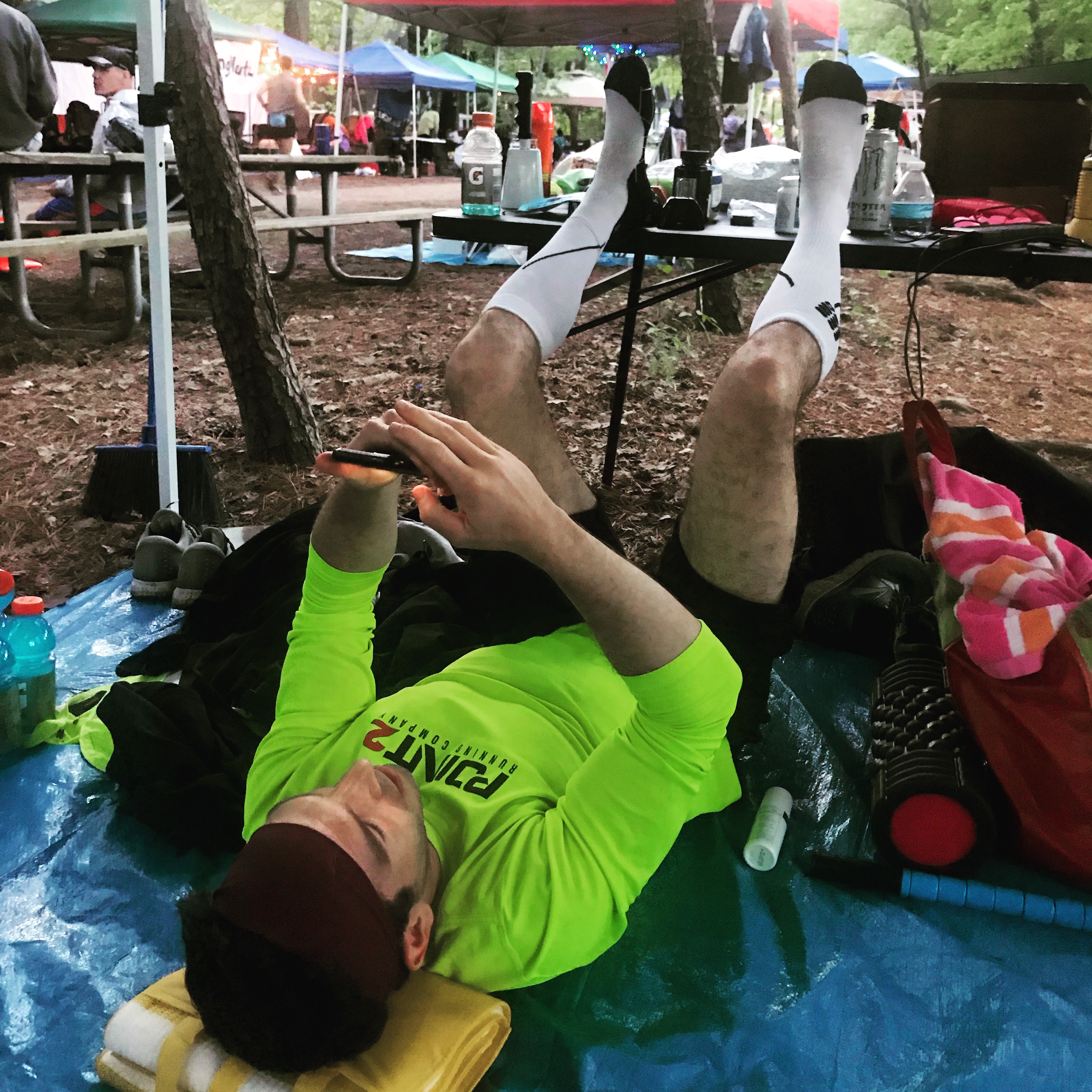
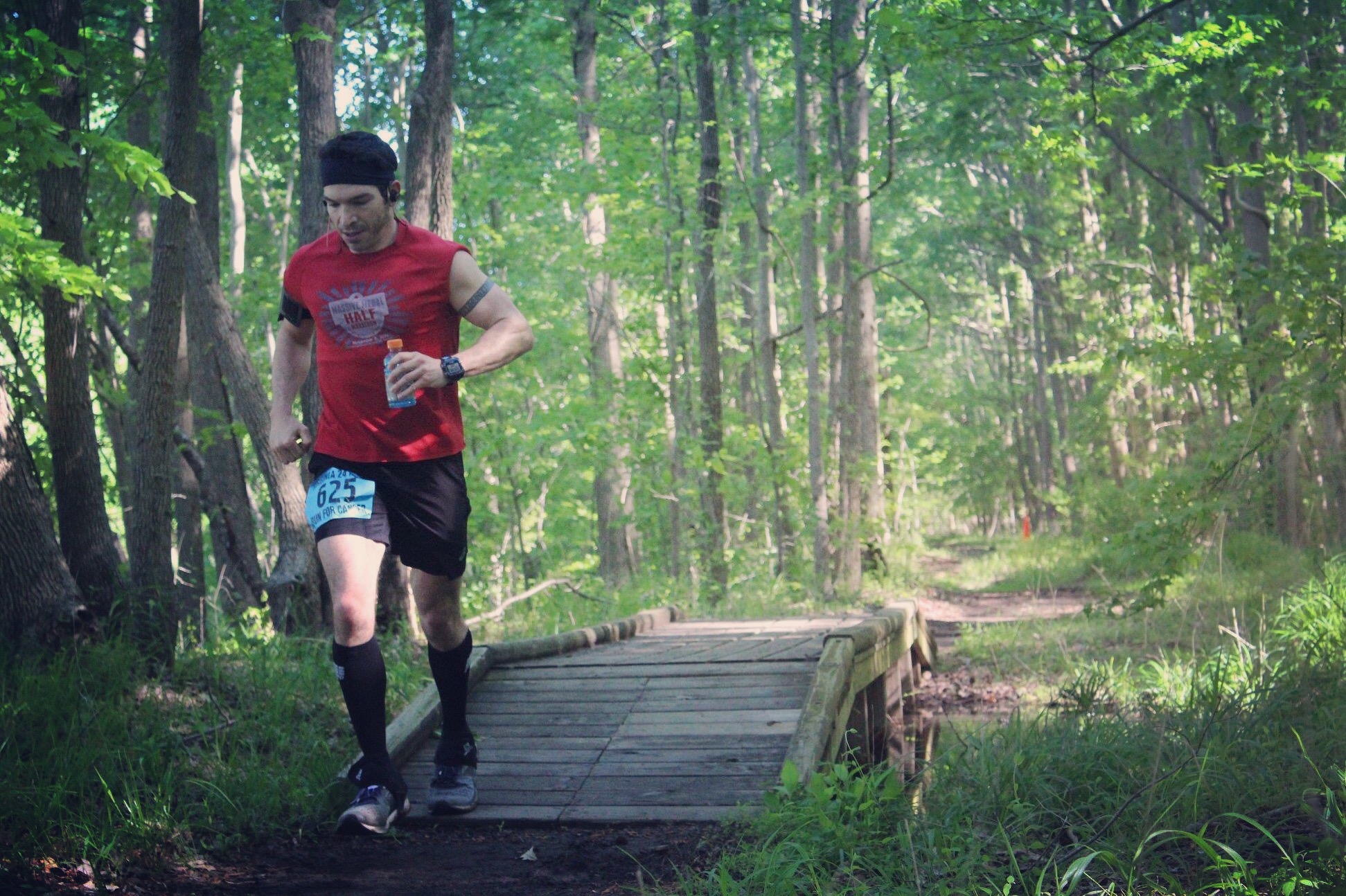
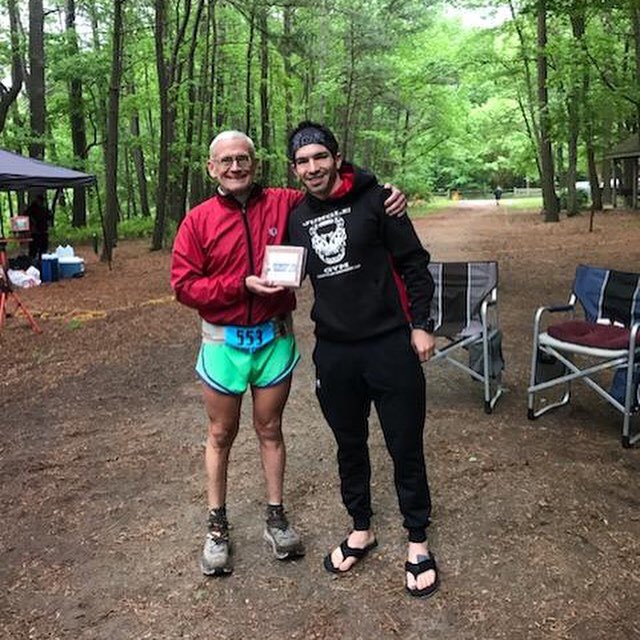
In Fall 2020, I decided I wanted to train for the 2021 Virginia 24 Hour Run for Cancer as a goal to work towards with the added downtime provided by Covid. I developed a training program that had me officially starting training in mid November. Over the next six months, I’d transform myself into a running/walking machine, ultimately setting myself up for a first place overall finish at the race. This blog post gives an overview of the most important components of my race preparation, saving the strategy/experience from the race itself for a separate one.

Ultramarathon Training

Ultra fitness is not the same as marathon fitness and therefore, ultra training should be approached much differently than marathon training – and that’s especially true for longer races like 24 hour runs. Ultramarathons are not necessarily harder, but they are definitely more time-consuming to properly prepare for.

24 Hour RaceMarathon
Pace13:00 min/mi7:00 min/mi
Mileage100+ miles26.2 miles
Duration24 hours3 hours
My target pace, mileage, and duration for a 24 hour race vs. marathon. Totally different races that require totally different fitness & training!

I was time crunched while training for my first ultra attempt at the 2019 24 Hour Race. I basically trained for a marathon that took place a month or so earlier and then crammed in a few long training runs afterwards. This time around, I was determined to set aside more time for training and put in significantly more mileage so I could prepare specifically for the unique challenges of the race. Below are some of the main keys of my training approach for hitting high mileage, staying injury free, and preparing mentally for the 2021 24 hour race.

My Five Keys for Ultra Training for the 2021 Race

1) Slow & Steady Mileage Progression

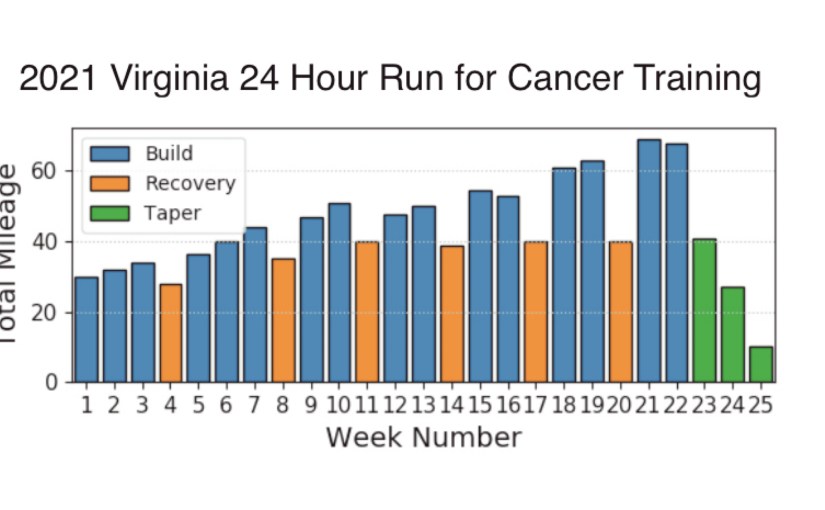
A well-programmed training plan with proper mileage progression is the key to successfully preparing for any endurance race. Below is a look at my total weekly mileage over the course of six months of training for the 24 Hour Race:

Without giving away too much of the secret sauce in my endurance programming 🤓, here are some of the highlights of my progression:

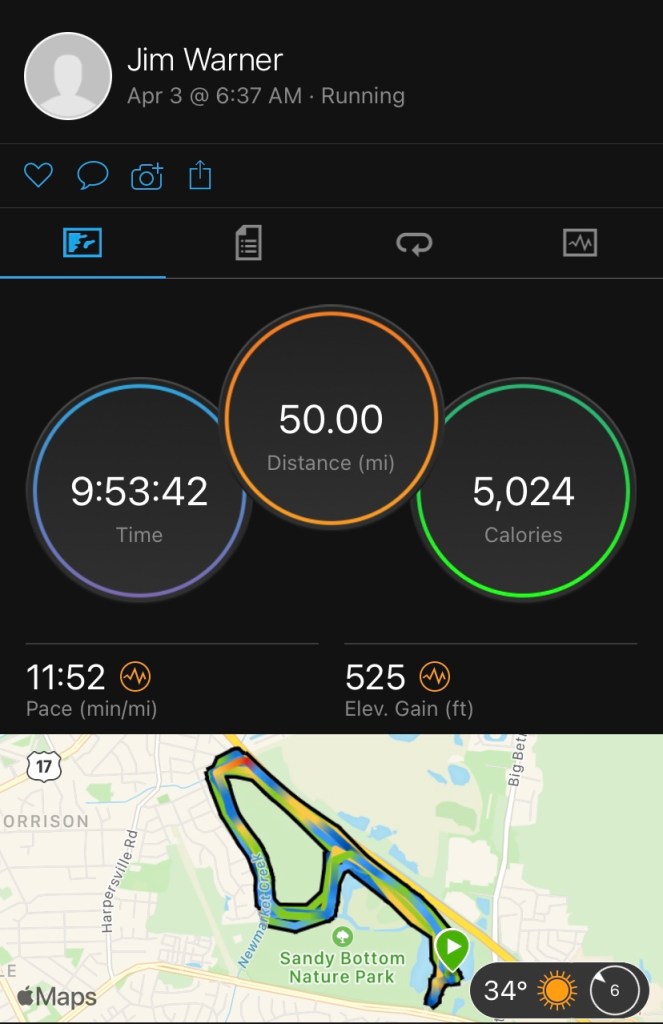
Grand finale 50 miler training run
  • Maintained a base of 30 miles per week for 2 months prior to starting the “official” training program showed above
  • Used a slow & steady progression from 30 to 70 miles per week roughly following the “10% rule” for mileage increases
  • Dropped from a standard “3 up 1 down” (i.e. three weeks of increasing mileage followed by one recovery week) training cycle to a more conservative “2 up 1 down” progression to give my body more time to adapt to mileage with more recovery weeks
  • Programmed a 25 week training plan! This gave me plenty of time to ramp up mileage slowly & safely

In that same time, I ramped up my long run from a starting point of 13 miles to a grande finale 50 miler that I did three weeks prior to the race. I ultimately put in over 1000 miles to prepare for the race, spending on average 10+ hours per week working out (running + cross training), not including cool downs and recovery. That’s like a part time job!

2) Emphasis on Recovery!

Training = Work + Recovery! This key principle should always be kept in mind for any race prep. I knew I’d be putting in record high mileage for the work part, so I had to really emphasize recovery to stay injury free during training.

Recovery for me started with weekly rest & active recovery days. I’d typically schedule long runs for Saturday, a rest day for Sunday, and an active recovery day for Monday, featuring a slow, short walk/jog and yoga before ramping back up the intensity and duration on Tuesday.

I also stayed disciplined about my post-run recovery practices. Below is a video of a quick foam roll & stretch routine I tacked onto the end of most run workouts to give all of my primary run muscles a little TLC.

3) Focused Strength Training

I’m a huge proponent of strength training for runners and other endurance athletes in general – both for injury prevention during training and staying strong & maintaining form deep into races. So even though I was dedicating a ton of time to running for my race preparation, I still prioritized getting in 1-2 strength workouts per week.

Since time was at a premium, those strength workouts were relatively short and needed to be focused. I spent a majority of that time on lower body and core exercises to build and maintain a solid foundation for the wear and tear of high mileage. I also focused on any weak areas that had given me issues in the past, for example – targeting my hips and hip flexors with the exercises below:

I also really like balance exercises as an effective way to build stability and strength for distance running. Here are some of my go-to’s:

4) Mental Preparation

Every long training run is an opportunity to do a dress rehearsal for the race. These long runs aren’t just for physical preparation, they’re a chance to practice the mental/logistics side of racing. By the time race day comes, your routine – from the morning hours beforehand to the strategies used during the race itself – should be well-practiced and set in stone.

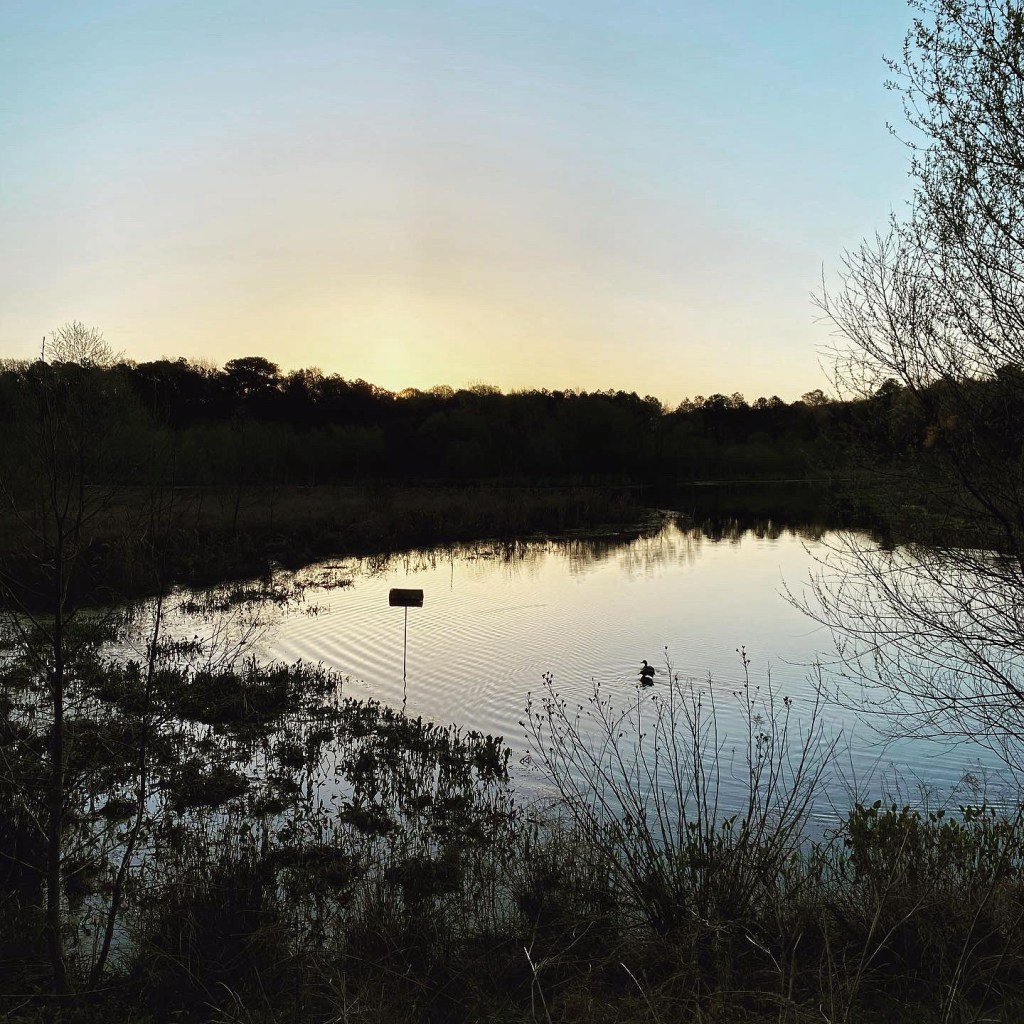
Early morning long training runs at Sandy Bottom Nature Park to practice on the race course.
The command station in my backseat – practicing race-day nutrition/hydration during long training runs.

I think the mental/logistics side of racing gets more important as the distance/duration of the race increases. So I used all of my long training runs to practice my strategies for nutrition/hydration and pacing. I experimented with different combinations and amounts of Tailwind sports drink, energy gummies, and PBJs to find what gave me the right amount of energy without causing stomach issues. I also tested out different run/walk time intervals to land on one that kept my legs the freshest for longest. I made it a point to do as many long runs as I could at the race course to familiarize myself with the trail and also practice fueling/hydrating between 3.75mi laps.

5) Embracing Walking

Let’s face it – walking as part of endurance training isn’t very glamorous. Walking or walking/jogging workouts might not make for the most flashy social media posts. But walking is a critical part of proper ultramarathon training – especially for a longer distance like a 24 hour race where the large majority of competitors spend much more time walking than running.

I knew walking had it’s place in training in my 1st ultra attempt, but I fully embraced walking in my second go-around, eventually learning to love the slower paced and longer training runs. I got to the point where 3 out of 4 of my main weekly “run” workouts had significant amounts of walking. Ultimately by race day, I felt like I could keep moving forever – provided enough of that moving was done by walking. Slow & steady wins the race.

Stay Tuned…

These were the keys to my ultra training 2021 Virginia 24 Hour Run for Cancer. I’ve never felt more prepared for a race than I did for this one. Having more time for training (thanks Covid) played a big role, but the knowledge I gained from my first attempt was a huge factor as well. Stay tuned for the next blog post where I detail my race strategies and talk about the experience of winning first place overall in the race.

Conquer The Cold

8 tips for powering through cold, winter runs.

When I started my running career I was living in Upstate NY where the cold and snow could be brutal and winter seemed to last for half the year. So now that I’m living in Virginia, I’ll take training in the mild winter “cold” here over the steamy summer heat any day.

But if you live in a colder area, or otherwise dread lacing up the shoes for a cold, winter run – I’ve put together a list of tips to help you keep logging miles through the winter months to prepare for those spring races.

1) Gear Up

One of the great things about running is how cheap and accessible it is – just buy a decent pair of shoes and hit the road. But when it comes to winter running, investing in some quality cold weather gear will really pay off in the long run. Pay a little extra for lightweight, moisture-wicking materials designed for exercise over heavier, cotton apparel. I personally feel that comfort in the cold starts with warm ears and hands, so a headband or ear muffs and a quality pair of gloves should be high on the priority list. From there, invest in a base layer of compression tights and shirt. See the gear section below for more suggestions.

2) Layer Up

Your body warms up quickly as you get moving, so wear layers that can be easily shed as you get further into your run. Plan a short warmup loop (1-2 miles) that brings you back to where you started where you can ditch some gear for the rest of the run.

3) Dress Like It’s Warmer Than It Is

A good rule of thumb is to dress for a temperature that is 10-20 degrees warmer than the “feels like” temperature with wind chill. It’s preferable to feel a little bit cold at the beginning of the run rather than overheating later on. Note that you can still put on an extra layer to start that you plan on ditching as you warm up as mentioned in tip #2 above.

4) Warm Up Inside (Pre-Run)

The hardest part of a winter run is often the moment you step outside and feel the brisk cold for the first time. So opt for an indoor warmup beforehand in an effort to make that cold air feel a little more refreshing and a little less frigid.

Get the blood flowing before you go outside with some dynamic stretching, drills, yoga flows, jumping jacks, etc. One of my past go-to’s was climbing several flights of steps in the stairwell of the apartment building prior to my runs. Do just enough to start feeling warm without sweating too much.

5) Warm Up Inside (Post-Run)

Your body temperature will drop quickly after you’ve finished working out, so make it a priority to get indoors and out of the cold shortly after your run is complete. Don’t completely skip your cooldown jog/walk, but keep it relatively short. Take a hot shower, put on warm, dry clothes, and enjoy a hot beverage or soup (bonus electrolytes!) to warm up. If you’re not finishing your run at your own doorstep, pack some dry clothes and a jacket to put on afterwards.

6) Game Plan for Winds

If you can help it, start your run heading into the wind and finish with the wind at your back. This way you don’t have to get blasted by a brisk headwind after you’ve broken a sweat.

7) Keep Your Lungs Warm

A common complaint of winter running is difficulty with breathing and throat/lung discomfort from the cold air. Focusing on breathing through the nose can help filter and warm the air before it gets to your lungs. You can also try running with a face mask or buff to achieve the same effect with either nose or mouth breathing (in case you have a runny/stuffy nose).

An alternative (and possibly more reliable) approach to alleviate lung discomfort is to simply lower the intensity of your runs to avoid huffing and puffing the brisk air. Stick to conversational paces and lower heart rate zones versus speed work and tempo runs on days that are especially cold. Besides, the winter months are generally a good time to focus on building endurance and aerobic capacity before honing your speed for spring races.

8) Stay Hydrated!

It’s easy to forget about hydration when it’s not hot and steamy outside, but you will still sweat considerably if you’ve bundled up for your winter runs. Follow your regular hydration routine even for cold weather running.

My Gear Suggestions Based on Temperature

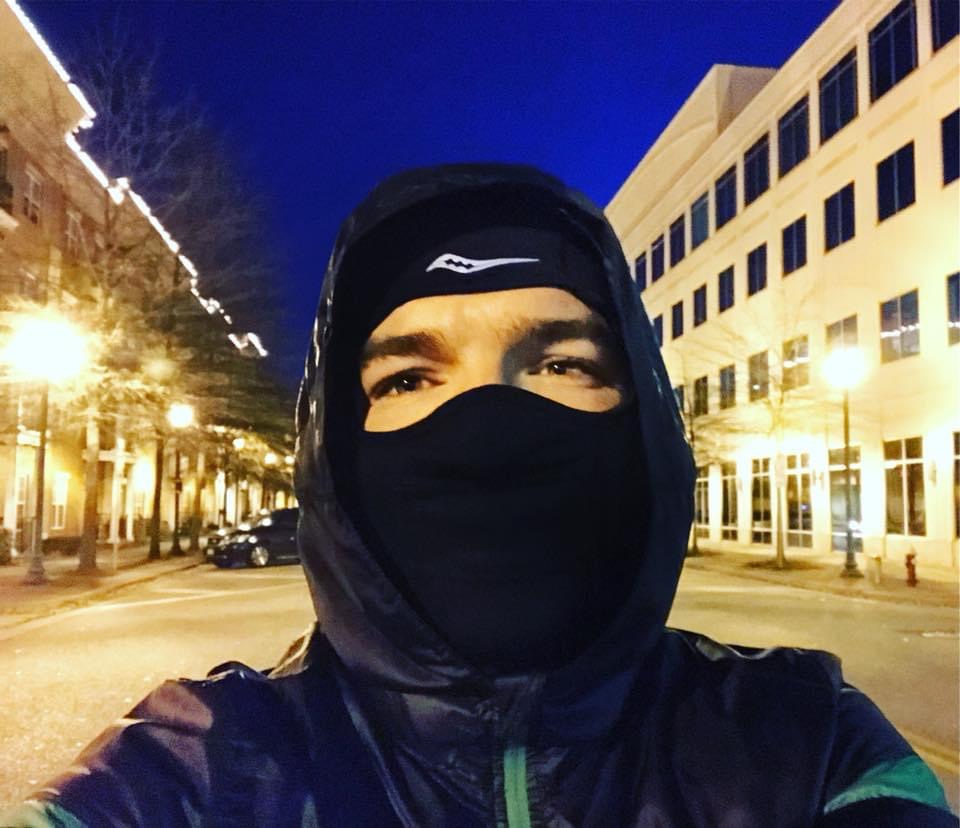
Break out the face mask for really cold runs!

Here I’m providing my personal preferences for gear based on the temperature outside. Obviously tolerance for the cold varies a lot from person to person and also changes significantly over the course of winter as we get better acclimated, but hopefully this is a helpful starting point if you’re new to winter running. It’s super helpful to be able to check the weather forecast before bed and know exactly what gear needs to be laid out for your morning run.

TemperatureLower BodyUpper BodyAccessories
40 – 49 degreesShorts, long compression socksT-shirt and long sleeve tech shirt or T-shirt with arm warmersGloves
30 – 39 degrees Compression leggings base layer, shortsCompression shirt base layer, T-shirt or long sleeve tech shirtGloves, headband/ear muffs
20 – 29 degreesCompression leggings base layer, shortsCompression shirt base layer, T-shirt or long sleeve tech shirt, windbreaker jacketGloves, headband, buff neck/face warmer
10 – 19 degreesCompression leggings base layer, shortsCompression shirt base layer, T-shirt or long sleeve tech shirt, windbreaker jacketGloves (with hand warmers), face mask
0 – 9 degreesShortsTank top(I’m on a treadmill 😜 )
My personal preferences for cold weather gear based on the temperature. I’ve bolded gear that has been added from the row above it to highlight how new layers/accessories are added to deal with increasing cold. Note that I’m treating the temperature here as the “feels like” temperature that factors in wind chill.

I really like gear that can be easily adjusted or taken off as I get warmer or colder over the course of a run – like convertible gloves (switch between mitten/glove), headbands (cover/uncover ears), buff (cover/uncover nose & mouth), arm warmers (peel off and put in waist band), etc. Check out this article that gives a good overview of different gear options.

Hopefully this helps you power through your winter training – keep building up that base mileage and keep your eyes set of those warm, spring races!

Beat the Heat

7 Tips to Stay Cool & Safe During Summer Training

Let’s face it – running during the dog days of summer is always going to be tough. But there are plenty of ways to make summer training more bearable. I put together this list of tips to help keep you cool and safe for your runs this summer.

1) Ease into summer training

It can take a few weeks for your body to physically acclimate to the hotter weather and start cooling yourself more efficiently while running. As the summer begins to really heat up, it’s a good idea to reduce your mileage by 10% or so and take a break from high intensity workouts for a couple weeks. For the many runners eyeing fall races, this is good time to start building up a solid aerobic base with slower running.

2) Slow down (& embrace it)

It’s totally unrealistic to expect to maintain your usual paces from winter and spring during the hot summer months. But that’s fine! It’s not the pace of your runs that’s important in your training, it’s the intensity of your runs that counts. And the same pace that feels comfortable in cooler weather feels significantly more intense when it’s hot. Just another reason why you should be training by effort (heart rate or perceived exertion) rather than pace.

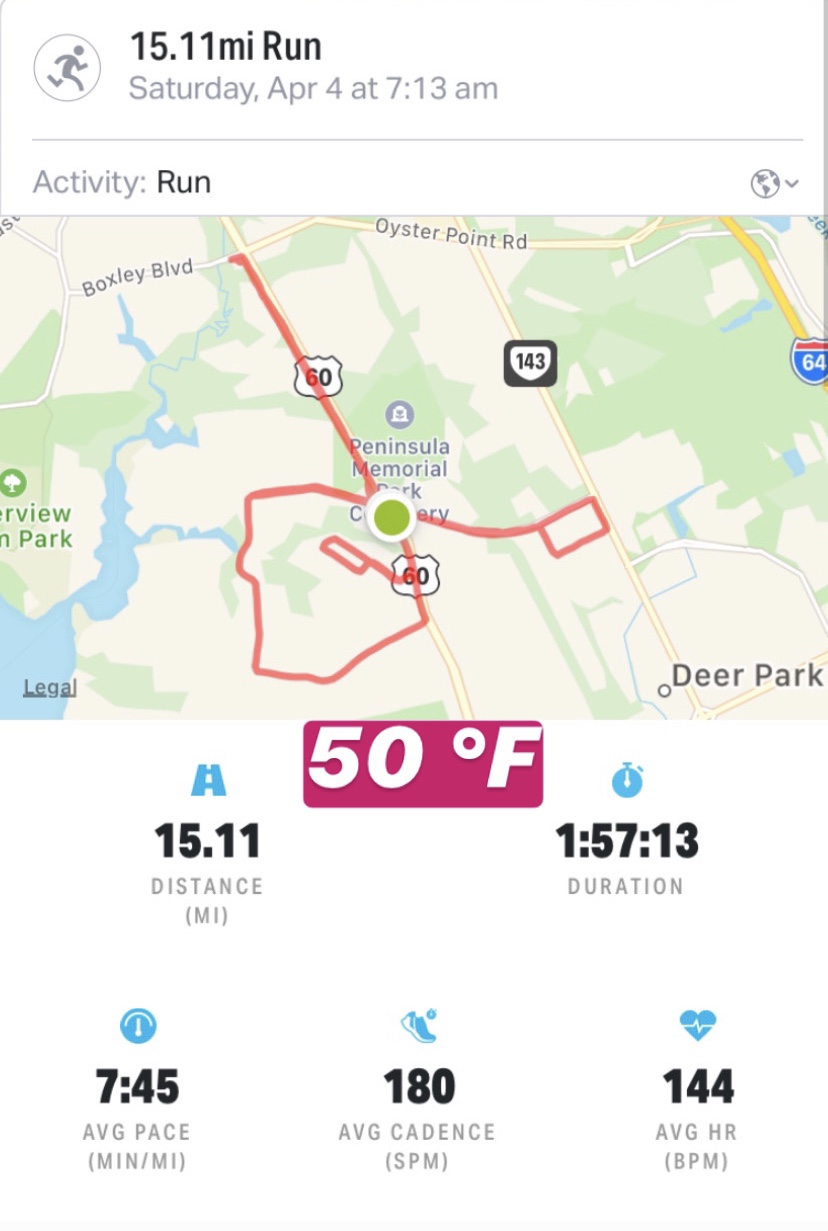
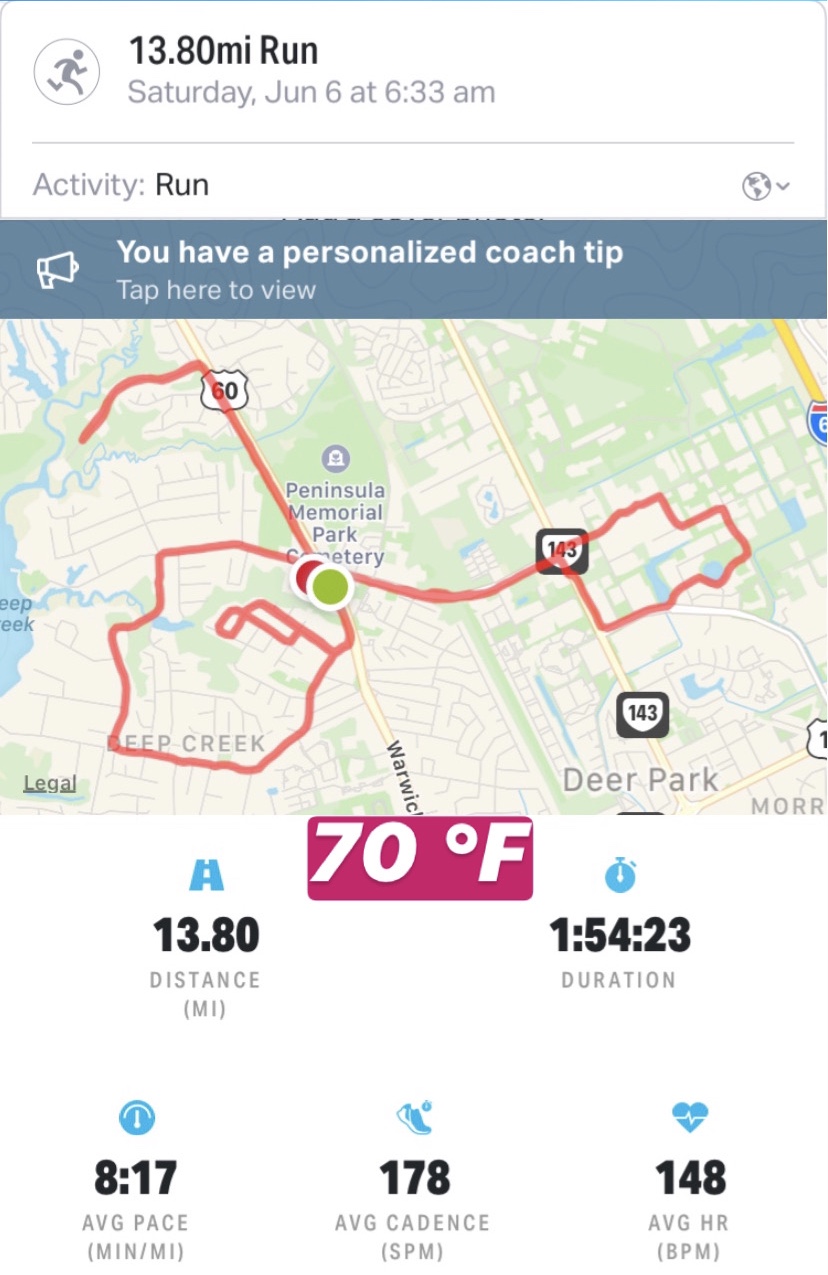
Here’s a quick example from my training this year. I ran for a similar amount of time and on a similar route on April 4th when it was 50 degrees out and June 6th when it was 70 degrees out. That 20 degree difference slowed down my pace by 30 seconds per mile and felt more intense (higher heart rate).

I know that “run slower” is easier said than done; no one wants to feel slow. I use a couple simple tricks with my Garmin watch to help embrace the slower running in the summer. First, for most of my runs, I use a watch display that does not show my pace. In fact, for long runs, I use a display that simply shows my heart rate and total time/distance. That’s it. Sometimes I go even further and turn off my auto-lap notifications for each mile. This way, I can zone out and just keep my mind on staying in the right heart rate zone without paying attention to pace and getting regular reminders of how much I’m slowing down. Again – it’s the intensity of the run that matters, not the pace, especially for long runs.

3) Stay hydrated

Probably a no brainer – but hydration is key to beating the heat! What’s less obvious is how to fine tune your personal hydration strategy since sweat rates vary a ton from person to person. A rough rule of thumb is 4-6oz of fluids every 10-15 minutes of exercise. You can also do the sweat test to get a more personalized estimate. For long runs in the heat, make sure you’re drinking regularly throughout the run by either carrying drinks with you, breaking your runs into shorter loops, or stashing drinks beforehand along your route. Finally, use plenty of ice and/or insulated water bottles to make sure your drinks stay cool and refreshing!

4) … but don’t forget your electrolytes!

Did you know it’s dangerous to drink too much water without replenishing your electrolytes? Hyponatremia is a condition that occurs when sodium levels in the blood are low, caused by over-drinking and/or neglecting electrolyte intake. Even in less dangerous scenarios, a lack of electrolytes can lead to painful muscle cramps during exercise and generally lower performance.

Like hydration, an individual athlete’s electrolyte needs can vary quite a bit. A rough rule of thumb here is 400-800mg worth of sodium per hour for longer workouts in the heat. A good starting point is to opt for getting all of your hydration from a sports drink instead of water for workouts lasting longer than an hour. I also like salt capsules as a quick and convenient way to boost my electrolytes.

If you are a “salty sweater” (if you ever notice a salty residue on your clothes after workouts), you should pay special attention to replenishing electrolytes during/after your runs. Same goes for everyone at the start of summer when your body is still acclimating to the heat and regulating your sweat rates.

5) Avoid the Heat

Do your best to avoid running at the hottest times of the day – opt for early morning and evening runs. I know here on the East coast it can still feel toasty & humid even before sunrise, but avoiding direct sunlight makes a huge difference. On that note, choose shaded routes and trails when possible. When it’s super hot (90s+ with humidity), it might be time for a treadmill or another indoor cross training workout instead 😅.

One caveat to avoiding the heat is when you’re signed up for a race that is traditionally done in hot weather. In this case, you may want to introduce short (~2-3 mile) runs during the hottest portion of the day to start specifically preparing your body for the race day stress.
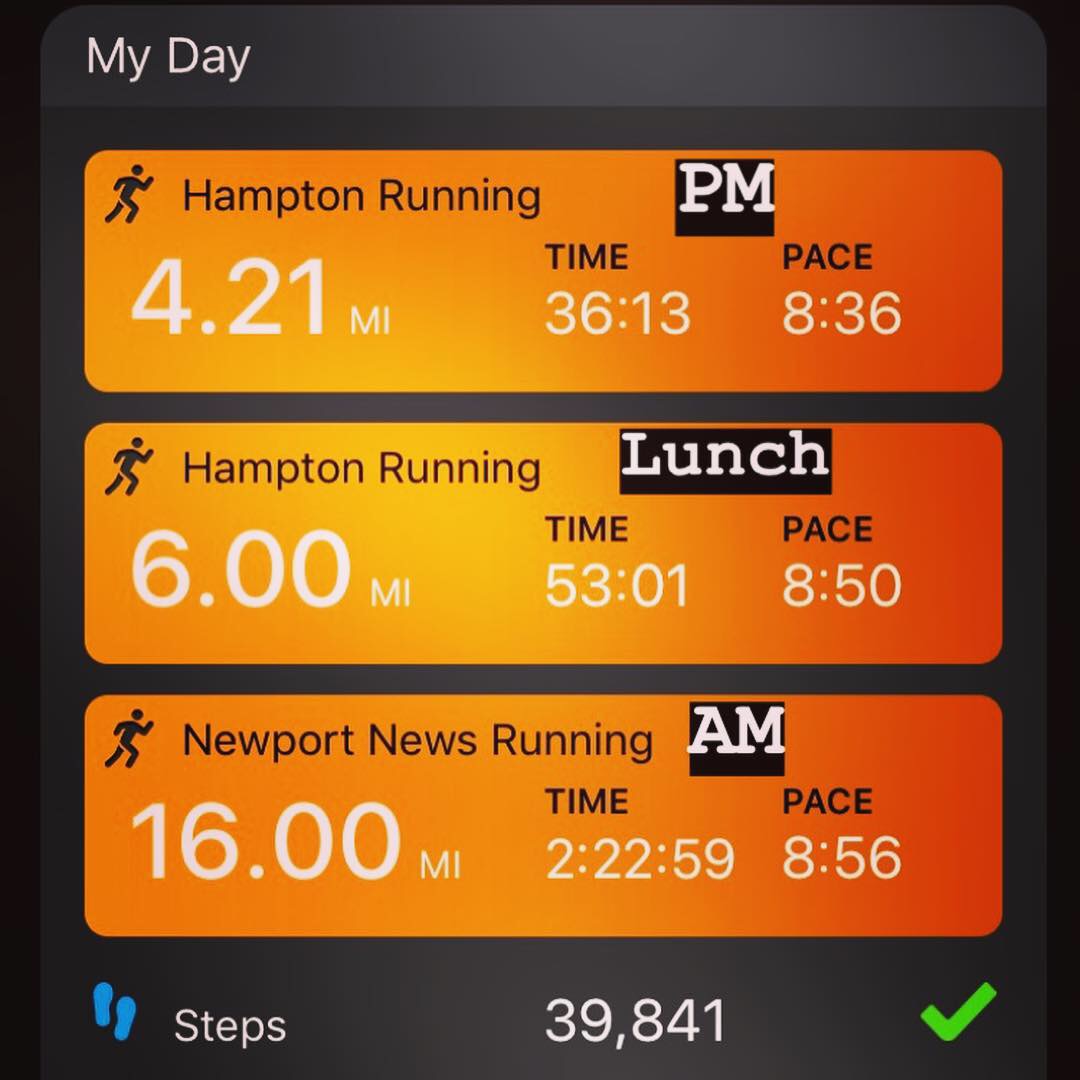
6) Choose your clothes and accessories wisely

The clothes and gear you choose can make a big difference in your ability to beat the heat as well. Choose light-colored, loose-fitting, moisture-wicking clothes over dark, heavy, cotton shorts and shirts. Keeping your face out of the sun with lightweight hats and visors can make you feel significantly cooler on a hot run too. And oh yeah, don’t forget to wear sunscreen!

7) Keep your eyes on the prize!

Training through the dog days of summer is tough. It’s easy to feel rundown and start losing confidence in your speed and endurance in July and August. But hang in there! All these tough miles you put in during the summer heat are making you a tougher runner. In fact, it’s been shown that training in the heat has similar advantages to altitude training. So keep your eyes on the prize, your steamy summer workouts will all pay off when the weather cools down for your fall races!

winter is coming GIF
Winter (and Fall) is Coming

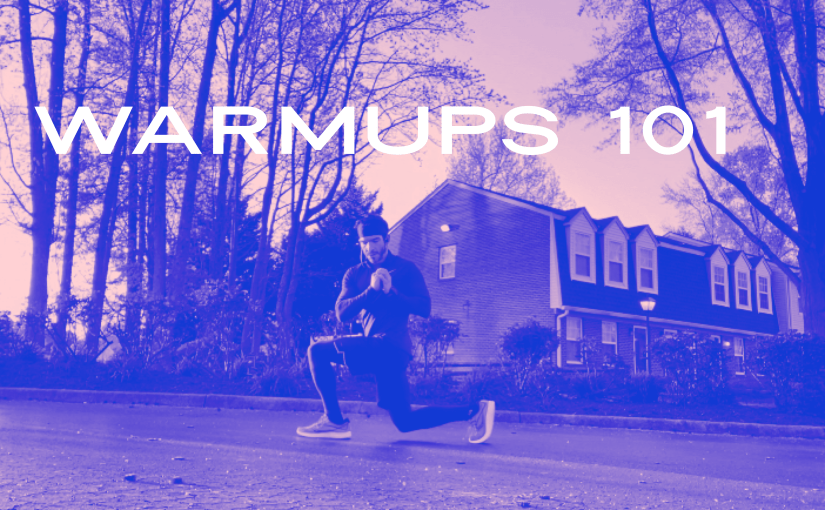
Warmups 101

Prep your body for exercise to improve performance & decrease injury risk

Man, I cringe whenever I see someone hop on a treadmill next to me, crank it up to 8.0, and start immediately slogging away, huffing & puffing. Or the guy at the gym who walks out of the locker room, loads the bench to 225, and barely squeaks out 7 reps on his first set of the day.

If you aren’t properly preparing your body and mind for your workouts or races, you’re likely not reaching your peak performance and you’re increasing your risk of injury. Have you ever had those runs where you just feel like garbage and you’re not sure why? Or the days where the weights just feel super heavy at the gym? Well there’s a good chance that stepping up your warm-up game can help limit those random workouts where you feel like the Tinman from Wizard of Oz.

Why Warmup?

Not only will a good warmup improve performance and decrease injury risk, it also prepares your mind for your workout, increasing your focus and tolerance for pain.

More specifically, warming up before your workout:

  • Directs blood to your muscles and raises your heart rate so you can get more oxygen to your muscles during your workout
  • Increases muscular elasticity and expands your range of motion
  • Promotes the flow of the synovial fluid that cushions joints and reduces friction
  • Raises your core body temperature (pro-tip – warmup indoors before cold winter runs!)
  • Makes it easier to control your heart rate and stick to your zones for heart rate-based training
  • Can accelerate recovery after your workout
  • Improves your mental focus and coordination and can increase your pain tolerance. Especially for those early morning workouts!

Warmup Tips & Ideas

A good warmup should specifically target the muscles that will be active in your workout. So a simple (but effective!) warmup is to just mimic the movements of your workout but at a reduced intensity.

For example, walk for 5 minutes then jog slowly for 5 minutes before a run workout. If you’re doing heart rate-based endurance training, make sure you slowly ramp up your heart rate until you reach your target zone, taking the first mile or so of your run to do so. For a strength training workout, go through your circuit for one round with 50% of your weights to go through the motions and get loose for the main workout. Do a few sets of knee pushups and arm circles before a heavy bench day. And so on. It doesn’t have to be rocket science.

I’ve included a few videos below that shown some specific dynamic stretches and drills for prior to running or lifting to give you more ideas.

How Long Should You Warmup?

It depends a lot on both the intensity of your workout and your age. A warmup probably isn’t very important if you’re a 20 year old setting off for a long, slow endurance run. But if you’re middle-aged and preparing for an interval session or an intense circuit-style workout, for example, you really should set aside extra time for a warmup. If you’re looking for a rough rule of thumb: 10 minutes should do the trick for most workouts.

For races – it may seem counterintuitive that the shorter the race, the longer your warmup should be. This goes back to the workout intensity and the simple fact that you will be running harder in your short races. So, very little warmup (10 minutes or less) is needed for a marathon where you’re looking to conserve your energy and glycogen levels. While for a 5K, especially if you’re a competitive runner, you should adopt a warmup that lasts 15-20 minutes and contains both jogging, strides, and dynamic stretches and drills (see below)

Pre-Run Warmup Drills & Dynamic Stretches

The following video shows some of my go-to warmup drills before a high intensity tempo or interval session. I like to repeat some of all of these for five minutes or so after a walk or slow jog.

Pre-Workout Warmup Flow

The following video has a sequence of some dynamic stretches & yoga-inspired movements that make a great warmup prior to running, lifting, etc., sped up for viewability. I originally put together this routine for a client of mine who was returning from a lower back injury to loosen up his back and hips, but it serves as a solid full body warmup.

Pre-Workout Dynamic Stretching Routine

The warmup flow above is an evolution of the older one below (you can see I love “wipers” as a first, gentle movement in a warmup). I use these dynamic stretches specifically for waking up my hips and hip flexors before a run.

Other Ideas

A short and light yoga class or quick flow is a great way to warmup for running or lifting. Some people also like to foam roll before workouts to prime their muscles. What about static stretching? There’s some debate there, but I save static stretching for after workouts/runs and opt for light cardio and dynamic stretching before instead.

Whatever you do, just do something! Make it a routine. Your body will thank you for it.

Boosting My Run Cadence

And proving it with Garmin data

Last summer, following a short hiatus from running, I made a concerted effort to rework my running form as I began to ease back into training. My goal was to run more efficiently by reducing overstriding; focusing on increasing my running cadence with shorter, quicker steps. I was able to track my progress by monitoring my run cadence data (in SPM – steps per minute) measured by my Garmin watch. Over the last year, I can show I’ve boosted by cadence from a SPM in the 160s when I started, to around 180 SPM now! I’ll talk about how I showed my improvements using Garmin data and mention how the new, quicker cadence is paying off now.

Reducing Overstriding

A thorough explanation of overstriding can get pretty technical, and a tutorial on how to fix it would require at least an entire separate blog post; so I’ll keep it brief for now. Overstriding is super common among distance runners and occurs when your front foot makes contact with the ground in front of your center of mass while running, see below:

Overstriding (left) vs. a healthy stride (right)

As shown in the diagram, when your foot lands out in front of you body, the tendency is also to make contact with the heel first (“heel striking”), often with a straight leg. Doing so is essentially applying the “brakes” with each stride, making you less efficient. There is also a ton of impact absorbed by the rest of your leg and body by landing in this position, increasing your risk of injury. In fact, overstriding is often the root cause of many common running injuries like runner’s knee and IT band syndrome.

Landing under your center of mass while running (image on the right) can make you a healthier, more efficient, and ultimately faster runner. Increasing your cadence isn’t the only thing to focus on to reduce overstriding, but it is a very important component of improving running form. Plus – cadence is measured by most newer running watches, making it easier to see and track improvements made…

The Proof is in the Data

For any fitness goal, it’s really important to have a quantifiable way to track your progress. Whether it’s logging your weights/reps at the gym when training for strength, or monitoring your weight loss on a new diet, it’s motivating to see progress over time in an explicit way based on your goals.

So for me, the average cadence data measured by my Garmin watch was the perfect metric for me to track as I set off to increase my SPM. And because I’m a scientist & programmer nerd, I enjoyed taking this tracking to the next level with this blog post 🤓.

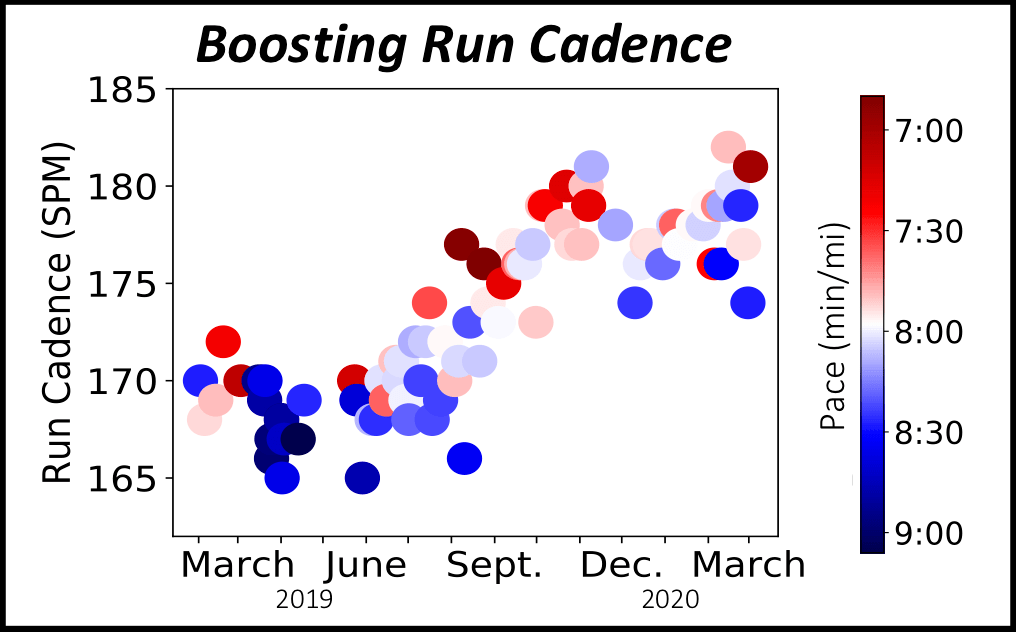
I downloaded one year’s worth of workout data from the Garmin connect app in spreadsheet form. I then wrote some code to load, process, and visualize the data. I filtered out all non-running workouts and runs with paces slower than 10:00 min/mi. I then plotted the average cadence from all remaining runs versus the time of year from March 2019 to March 2020 as circles, and colored those circles by average pace (blue for slower, red for faster). I wanted to be able to see how my cadence increased with time, but also how much the pace of the runs affected my cadence.

My average cadence from all runs between March 2019 and March 2020.

I was pumped with the result! I was able to clearly see a trend of increasing pace from June – October and it was obvious that my average cadence these days is signficantly higher than last year at this time. Also, I can see that even my slowest runs now have a higher cadence than my fastest runs back before I started. This is awesome, because it used to be a challenge to move my feet fast when the pace was slow.

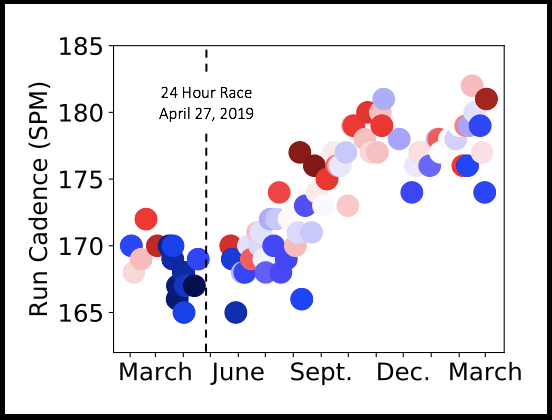
Same avg. cadence plot – with the 24 hour race indicated.

At first I thought I made a mistake in my data processing when I saw the gap in runs you can see around May 2019… but then I remembered I had ran in a 24 hour race on April 27th (my first ultra), and took a brief break from running afterwards to let my feet recover 😧. What’s also cool is you can see all of the slower-paced runs leading up to that race (the darker blue dots) where I was doing lots of long and slow walk/jog workouts to train.

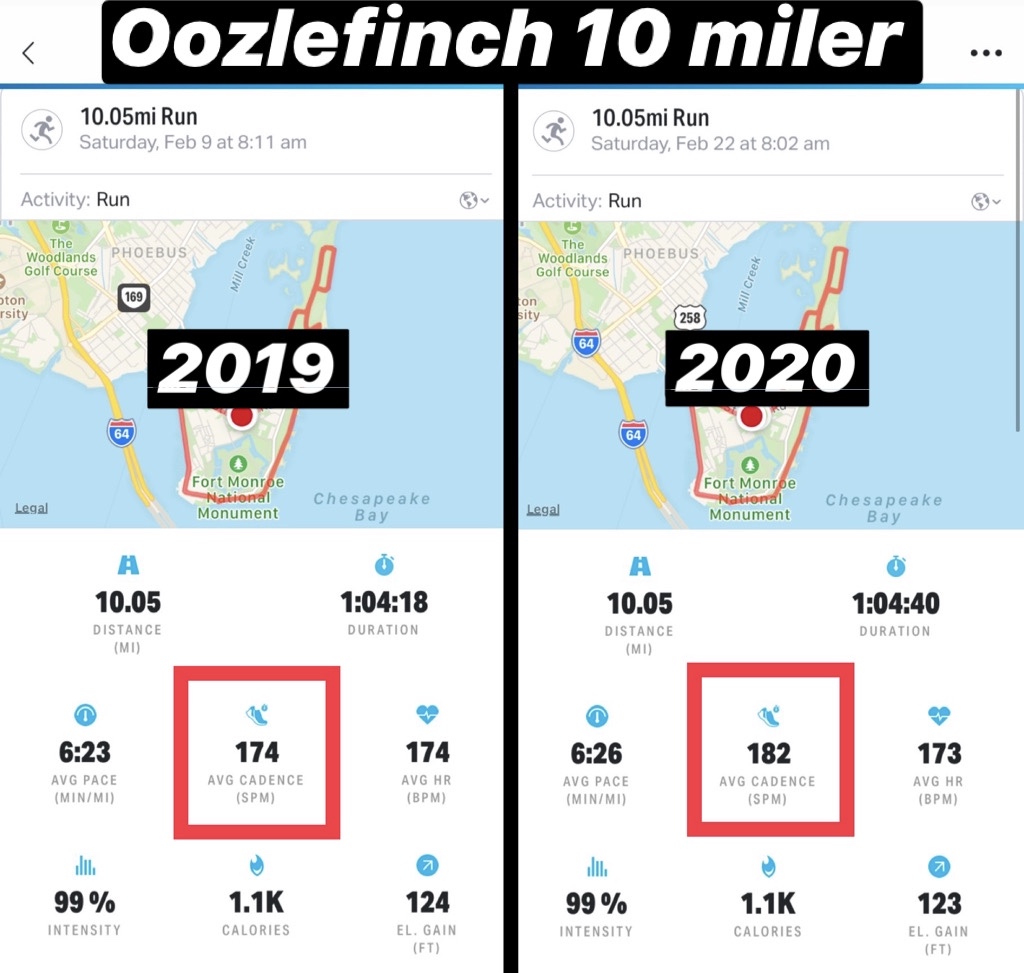
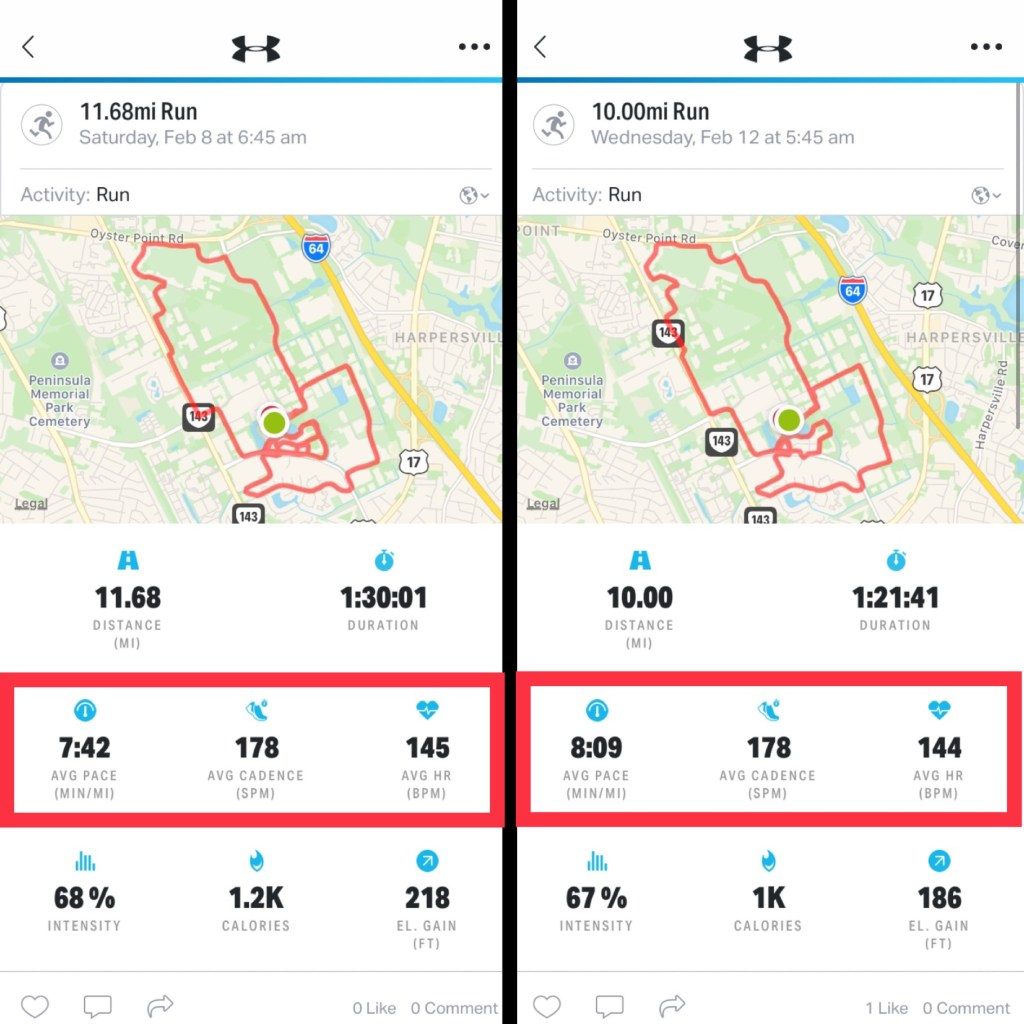
Further evidence of the improvement can be seen by looking at a couple races I did before/after making upgrades to my stride. Check out a comparison of my stats from Richmond Half Marathon (2018, 2019) and the Oozlefinch 10 Miler (2019, 2020) below:

The pace and finish times between the two years were remarkably similar, but my cadence increased significantly (I think the average cadence showed from Oozlefinch 2020 is actually slightly higher because I forgot to turn off my watch after the race for almost a minute 😅).

Feeling Lighter & Quicker

With an average cadence of around 180 these days, I’m feeling light and quick on my feet, even during the long, slow runs. Like learning anything new (or re-learning something you’ve been doing for years), it takes time to change, and even longer for the change to feel normal and second-nature. I’m just now getting to the point where I can keep my feet moving fast without focusing on making it happen.

With the exception of periodically tight/sore calves (landing on the balls of your feet as opposed to heels puts more emphasis on the backside of your legs, especially calves), the quicker turnover has my legs feeling fresher. It’s only been a relatively short period of time, but for what it’s worth, I’ve avoided any injuries/tweaks to knees/hips/shins/feet over this stretch.
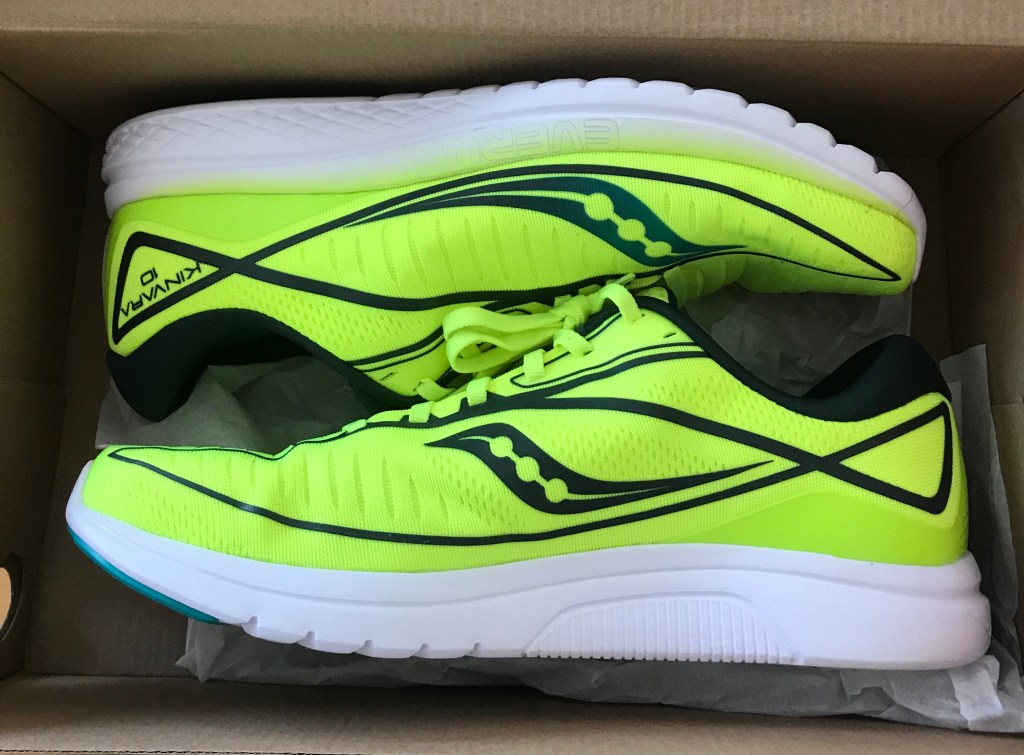
The healthier stride also motivated me to finally switch up my running shoes for the first time in over five years. I switched from the heavy and super cushioned Brooks Glycerin to the lightweight Saucony Kinvaras. The difference is huge: going from a heel-to-toe drop of 10.5mm to 4mm; and a weight of 11oz to just 7.8oz. It’s hard to imagine now how I ran with such heavy-duty shoes.

Saucony Kinvara: lightweight, lighting fast… and bright AF

Finally, another thing I love about changing my stride and focusing on fast cadence is having a new, powerful cue for the end of races and hard runs. I’ve noticed that when I get fatigued, my cadence tends to drop, even if my pace is the same. So now when I come to the final mile or two of a race, my internal cue is to keep quick feet. I bring up the cadence display on my watch and focus on keeping the number high. To me, it’s mentally easier to focus on fast cadence than focusing directly on fast pace… but the faster pace naturally comes with it.

Where to Start

Looking to learn a healthier stride? As I mentioned, changing something so ingrained over time like your natural running stride is going to take some time. The best time to make changes to form and technique is in the offseason or in between training cycles. You’re more likely to fall back into your same habits if you feel rushed and pressured to build speed and endurance for an upcoming race.

The first step is simple and is just about observation to find out where you’re at now. Look through your run data just to get an idea of what cadence range you tend to run at. Then change your watch settings to show your current cadence on one of your displays. Pay attention to how your cadence may tend to slow when you’re fatigued.

Once you have an idea of where you’re at – start small. Aim to increase your cadence by 5%. Add in drills at the beginning and end of runs that emphasize good form and quick feet like strides and downhill running. Although I haven’t tried this, some people even recommend running with a metronome to hit a target cadence. I also found an app that will change the tempo of your favorite music.

That’s it for now. I’ll put it on the to-do list to revisit this topic more from a how-to standpoint, but in the meantime check out some of the links in this post for more details. Happy running!

Core Exercise Compilation!

A compilation of 70+ fun & creative core exercises grouped by the equipment they require

Building a strong core is super important whether you’re an athlete or a weekend warrior. A solid core will give you the foundation to increase your strength and endurance, improve your balance and stability, and can improve your posture and help prevent injuries.

Since I became a personal trainer, one of my hobbies and coaching specialities has become concocting new and challenging (and sometimes off-the-wall) ways to work your core. I decided to go back and collect all the core compilations videos I’ve made over the last couple years into one place. The exercises are grouped by the equipment they require and chances are you own at least one (got one dumbbell??). Take a look and put together your own at-home core workout with the options below!

Jump ahead by section:

Foam Roller

The foam roller… not just for self-massage / myofascial release. The exercises:

  1. Plank walks (move forward to increase the challenge)
  2. Shoulder taps
  3. Forearm forward rollouts
  4. Reverse rollouts
  5. Side plank rotation roll-up

Combine 1-3 for fun combos. Or toss in the foam roller push up for an added chest and shoulder stability challenge. These exercises are deceptively hard if you don’t train your core regularly – set your feet up nice and wide, drop to your knees, and/or put the foam roller on a soft surface to decrease the difficulty at first.

Sliders

Sliders are an awesome fitness tool because they’re cheap and portable. You can get a complete workout with just one set and a small space on a floor that slides. You can also do slider exercises using just towels (or in your socks!) on a hardwood floor at home. This video has eight of my favorite core exercises that use sliders. Check ‘em out! The exercises:

  1. Mountain sliders
  2. Knee tucks (with obstacle)
  3. Around the worlds
  4. Three point knee tucks
  5. Pikes
  6. Plank slide outs
  7. Forearm saw
  8. Army crawl

My favorite way to get a good core workout with sliders is in the form of circuits or supersets. Pick 2-3 out of this list to perform back-to-back with no rest 💪⚡️.

Stability Ball

I like the stability ball because it forces you to use your stabilizer (duh) muscles to do the exercises clean and with control. With that in mind, it’s important to think about doing the reps of these exercises slowly and maintaining good form. You’ll notice that the one exercise that most people probably think of, the stability ball crunch, didn’t make the cut because I think these eight exercises are more effective! The exercises:

  1. Forearm saw
  2. Around the world
  3. Plank knee drives
  4. Dead bug
  5. V-up pass
  6. Knee tucks
  7. Mountain climber
  8. Side plank

This is the third time we’ll see a variation of the plank saw in this series (see sliders and foam roller), and I think this one is the most effective. It’s important to remember to really brace your core on this one and limit the range of motion if you feel any stress in your lower back – you’ll feel the burn with even tiny saw motions 🔥. The Around the World exercise takes the forearm saw to the next level, requiring more stability and control. Taking a nice wide stance on both of these exercises gives you more leverage and make them a little bit easier. I think a lot of these exercises are deceptively difficult, I’d recommend starting with the dead bug and V-up pass for beginners. I was personally caught off guard by how hard a side plank is on the stability ball is – give it a shot and let me know what you think!
Dumbbell

This video is cool because it’s practical – a lot of people have a pair of dumbbells lying around at home. Now you can go beyond your run-of-the-mill bicep curls and get a complete core workout with one of those dumbbells too! These are also solid exercises to know when the gym is packed and you wanna squeeze in some core work at the end of your workout – just grab a dumbbell off the rack, find a quiet corner, and let it rip. The exercises:

  1. Sit-up + oblique crunch
  2. Plank dumbbell push
  3. Plank dumbbell drag
  4. Plank fly
  5. Plank front raise
  6. Side plank raise
  7. Side plank fly
  8. Side plank hold (+ leg raise)

For many of these exercises (1, 4, 5, 6, 7), the lighter the dumbbell, the better. The challenge here is stabilizing your (side) plank while you’ve got the dumbbell movements altering your center of gravity, so no need to overdue it on weight. You’ll also notice that most of these exercises will secondarily work your shoulders, so I like to use these as a way to get my core work in at the end of a shoulder workout. Try exercises 1 & 2 back-to-back as a fun superset (~8 reps on the right then left for each). And give exercise 8 a shot if you’re getting tired (or too good at) holding a standard side plank.
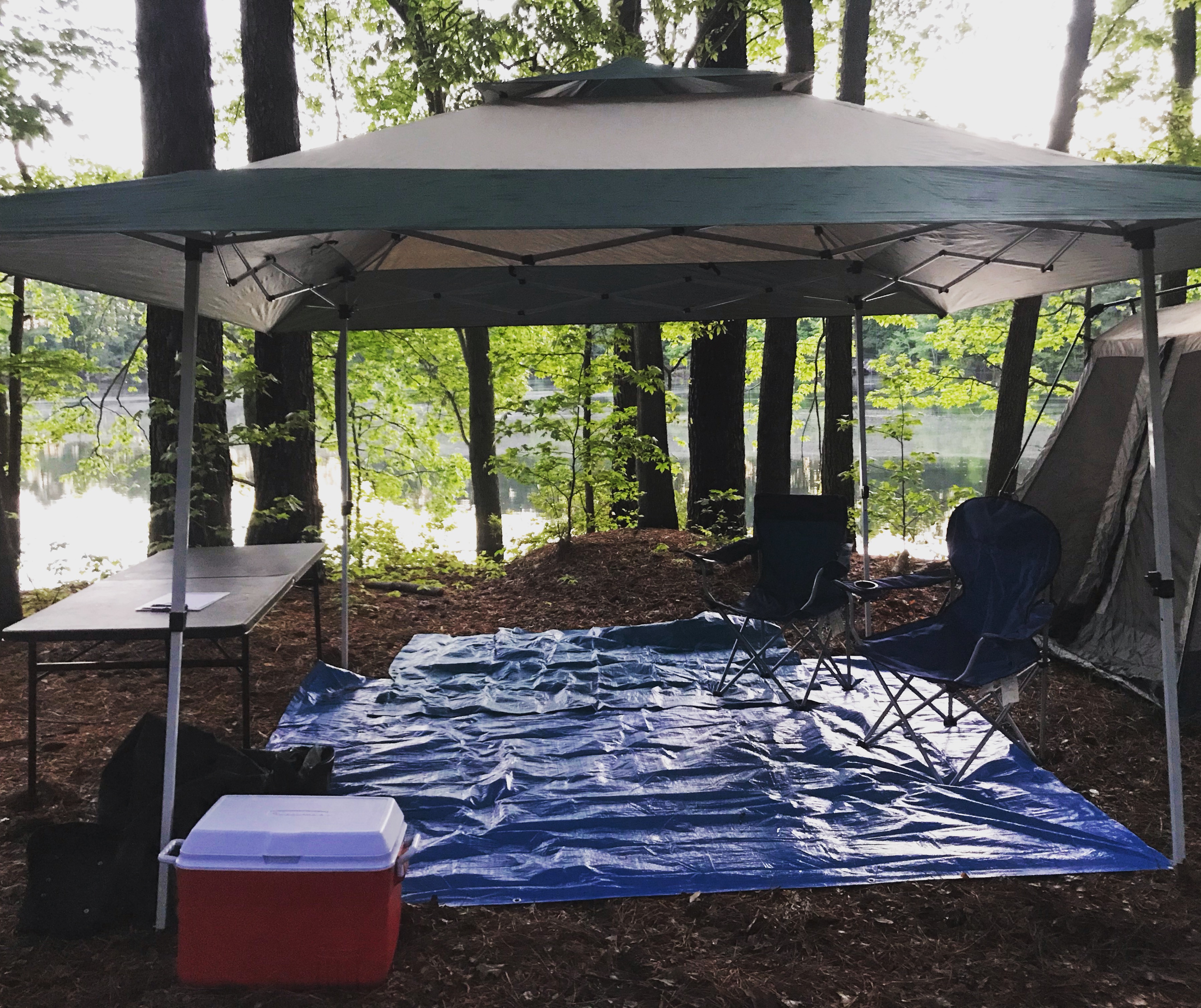
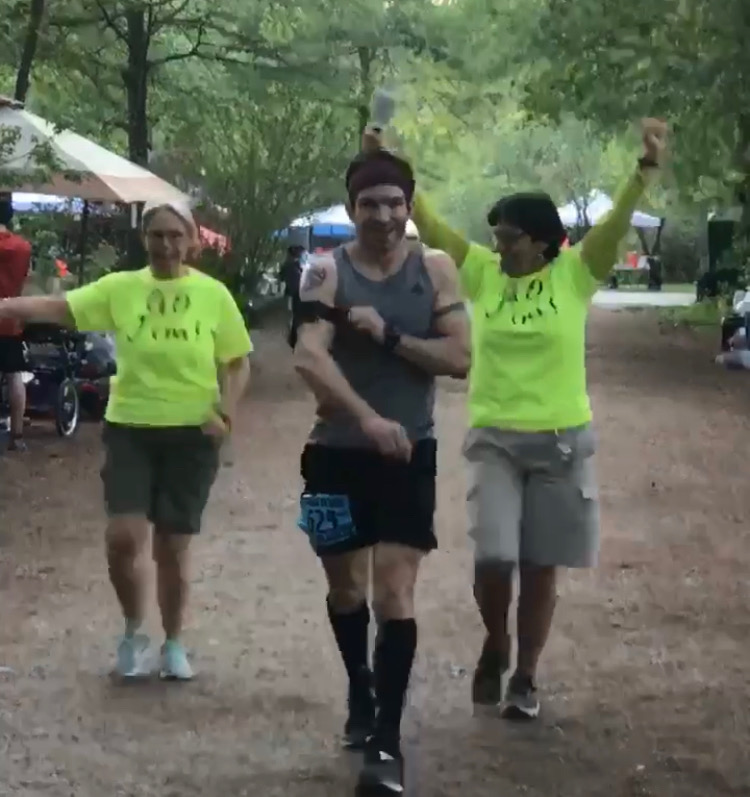
Kettlebell

Known mostly for ballistic movements and swings, kettlebells can also be used to light up your abs/obliques with these core-isolating exercises:

  1. Standing windmill
  2. Kneeling windmill
  3. Pullover
  4. Bicycle
  5. Windshield wiper
  6. Leg raise
  7. Russian twist
  8. Plank walk over

Some tips & cues: For the windmill exercises, think about trying to stack your shoulders at the end of the movement, keeping your eyes focused on the bell and the bell pointed straight up at the ceiling the entire time. I like to think about standing in a narrow space between two walls while doing the standing variation to keep my movement in the frontal plane. The kneeling windmill is a slightly more challenging variation, make sure you control your motion all the way to the ground, engaging your obliques to land softly on your hand.

For all the lying exercises (#3-6), focus on keeping your lower back pressed on the ground to keep your core engaged and your back safe. For the leg raise and windshield wiper, see if you can keep the kettlebell as still as possible by imagining that you’re pressing it up towards the ceiling (it’s hard to do with the wipers!). Keep a “proud” chest on the Russian twists, and rotate your shoulders as well to make sure you’re using your core. Pick a heavier kettlebell for the plank walk overs to make it more stable or go lighter if you want more instability for a good challenge.

Resistance Band

This video uses one resistance band (and anchor point) to do seven challenging core exercises, including two variations of a new favorite of mine, the Palloff press. Resistance bands are nice because we can easily control the resistance using distance from the anchor point, the more the band is stretched, the more challenging the movement. So make sure you get a good squeeze at the top of the movements when the resistance is highest! The exercises:

  1. Kneeling Palloff press
  2. Overhead Palloff press
  3. Side plank rotation
  4. Side plank row
  5. Side plank press
  6. Plank pulldown
  7. Band pull leg raise

As I mentioned, the Palloff press is one of my new go-to’s. It teaches and strengthens core stability, which is great for beginners learning to engage their core or for more advanced people building a solid foundation for more powerful lifts or endurance training. As you press the band away from your body, you need to use core stabilization to resist core rotation (for kneeling Palloff press) and lateral flexion (for overhead Palloff press). These are awesome exercises for your obliques and for shoulder stability too. For all the side plank exercises, think hips high & core tight. Try to rotate a full 90 degrees on the side plank rotation, pointing your elbow to the sky and straight out to the side. Drop to a knee, use a lighter band, or move closer to the anchor point to decrease the difficulty at first if needed.

TRX

Alright, alright I know everyone doesn’t have a TRX Suspension Trainer lying around their house. But most gyms have a couple of them. And more importantly, I think the TRX is probably the single most effective tool for training your core. With your feet suspended in the straps, your core works double-time to keep these exercises under control as you crunch/rotate/extend in the air with little leverage. The exercises:

  1. Knee tucks
  2. Mountain climbers
  3. Pikes
  4. Forearm saw
  5. Oblique crunch
  6. Knee tuck twist
  7. Side plank rotation
  8. Side plank crunch
  9. Side plank knee tucks

Exercises 1-4 target your abdominals while 5-9 primarily target your obliques. I like to select a few exercises from each group accordingly to emphasize one or the other in a single workout. Disclaimer: these core exercises on the TRX are pretty advanced. You can make them a little bit easier by backing up underneath your anchor point to create less resistance in the crunching/knee-tucking exercises (moving forward will make them more challenging). A good starting point is just working on your plank and side plank holds with your feet in the TRX. Once you feel stabile and comfortable here, you can start to experiment with the exercises in the video.

Slamball

Slamballs – not just for slamming! 🤓 Light up your core with these exercises:

  1. Sit up foot strike
  2. Knee tucks
  3. Sit up knee tucks
  4. Spiderman (incline/decline)
  5. Russian twist slams
  6. Plank Saw
  7. Side plank hip dip
  8. Side plank rotation
  9. Side plank heel/toe tap

➡️Beginners – start with exercises 1, 4, and 5 and modify the side plank exercises by putting your forearm on the slamball instead of your feet to make them easier. ➡️People with back issues – skip the knee tucks (2) and sit up knee tucks (3) or use a lighter slamball and make sure you’re keeping your lower back pressed into the ground throughout the movement (reduce your range of motion if you can’t). ➡️Runners – incorporate side plank hip dips (7) and heel/toe taps (9) into your strength training routine to work your core while getting some bonus hip abductor/adductor strengthening in for a sturdier foundation to prevent injuries!

Cable Machine

Last but not least, a rapid-fire video of 10+ core exercises for cable machines in 60 seconds 🔥 Most are rotation and anti-rotation that work your obliques and transverse abdominals (your deep/functional abs). The palloff press variations have been some of my go-to’s over the last couple years cause they don’t only work your core but require you to activate basically all of your major muscle groups. They’re also perfect for beginners and more advanced people alike. The side-plank row/press/fly exercises are awesome accessory work for your push/pull days at the gym…. And yes, I had to throw in some of the (boring?) classics like chops and crunches 🤷‍♂️ Give em a whirl! 💪

How Hard Should You Run? Follow Your Heart.

I think sometimes I sound like a broken record talking about how and why to use heart rate-based training for runners and triathletes. But I wanted to beat that drum a little bit more and give a quick example from my own training with a couple runs I did last week. I also wanted to show that, even though I’ve trained like this for years now, I still have seemingly “bad” runs with the approach, but that’s okay. I keep plugging along and trust the process. 

I’m showing an image comparing two runs from last week, four days apart, nearly identical route, similar conditions, with more-or-less the same heart rate. But I was about 30 seconds per mile slower in the second run shown on the right, and for a shorter distance. Bad run right? Nope! I was patient. I executed the run just as planned. I followed my heart. And it wanted me to have a slower run on that particular day. 

Running by heart rate…

Heart rate training is all about listening to your body. Wearing a heart rate monitor while you run and workout is the most objective way we have to gauge effort level and understand the stress your body is under. There is also a lot of research and different approaches to tell you the specific training effect that running in different heart rate zones will produce. So, I argue that (in most cases) we should set target heart rate zones for our runs, and let the pace be what it may. Rather than setting a target pace for our runs, and letting your heart rate, workout stress/effort, and resulting physiological impact be what it may. 

Running by pace…

Sure – running according to a specific pace is probably the first and simplest approach most runners use when they’re starting out; and one that many people stick with through their running career because it’s so simple (and because it’s fun to show off how fast our long run was :-P). For example, “I want to do all of my long training runs at 10:00 min/mile for this upcoming marathon”. But, how does that 10:00 min/mi pace feel to you when it’s 40 degrees out versus say, 85 degrees? With/without the Virginia summer humidity? Or running on the flat road versus up the side of a mountain on a trail? Or when you’re well-rested versus sleep-deprived and recovering from a cold? You get the point. A difference in conditions like these can turn a leisurely afternoon stroll into an near all-out effort. So are you still getting the the training effect you intended on with your long run in those cases. Probably not. 

Running according to heart rate takes these conditions into account. When it’s hot, heart rate is elevated, naturally slowing your pace to level out the effort and training stress. Same thing with hilly terrain or humidity. It’s also known that higher heart rate can be a leading indication of a pending cold or sickness. Your heart rate will also naturally be higher when you’ve missed sleep or if you’ve been stressed. This is your body asking you to slow down. And following your heart rate monitor for your run will meet that request. It’s a more direct reflection of effort. 

Running by feel…

Alternatively, you could run by feel instead of by pace or heart rate. And for many seasoned runners, this is a valid option. However, what’s going on in your head and in the rest of your body can be completely different. How many times have you surged out of the starting line of a race fueled by adrenaline. Only to crash and burn a couple miles after you realized you’re running wayyy too fast. 

Running according to heart rate can also be a great pacing tool for these situations. The more you become aware of the connection between your heart rate and effort level, the more you understand how much longer your body can continue to run at a certain heart rate. So, when race day comes – you’ll have your heart rate monitor as an objective voice yelling “slow down!!” after you shoot out of the gate. 

Wrapping it up…

Back to my “bad” run on the right. I don’t know the exact cause of the slower pace. I hadn’t slept quite as much as I would’ve liked over the few days in between, maybe that was it. Maybe I wasn’t fully recovered from the run on the left (my farthest in quite a while). Maybe my body was feeling more stress than my head was leading me to believe.

I do know that my 8:09 min/mi pace was exactly what it should’ve been for that day though. Because pace is the result of my run, not a set target I’m aiming for. Yeah, I’d like for all of my runs to be “fast” and increasingly fast, but I’m in it for the long haul. I just want incremental progress over time. And I nailed the target heart rate to get the training effect I’m looking for to keep that progress rolling, and that’s what counts. 

My First Ultramarathon: The Virginia 24 Hour Run for Cancer

Last weekend I raced in the Virginia 24 Hour Run for Cancer, my first ultramarathon. I managed to cover 90 miles, earning an award for the best mileage for a first time ultra attempt. I had a great support crew who helped make that possible, and learned a ton about ultra-endurance training from my preparation. Here’s a not-so-quick recap of the race and the training that went into it.

Worked hard for this thing!

It’s funny, a lot of people keep asking if (or assuming that) last weekend’s 24 hour race was the hardest endurance challenge I’ve ever done. But honestly, I don’t think that it was. It was just different. It was tough for sure, but a different type of tough. Compared to a marathon, the intensity of the pain/discomfort was a bit less, but it was just stretched over a much longer time. There’s more emphasis on strategy, pacing, nutrition, and logistics. The performance balance is shifted a bit from pure physical ability to mental toughness and experience. Proof of this: the number of people in their 40s, 50s, and up who are in the top 20 runners – there’s a 60 year old lady ranked right in front of me with 93.5 miles!

Quick Training Recap

With much more focus on strategy and experience, and me being totally new to the ultra game, there was a ton for me to try to learn in the couple months leading up to the race. See my last blog post for some more details on how I was planning out my training. As I mentioned there, I was pressed for time, with only 8 weeks between a Spring marathon I had trained for and the 24 hour race, minus a few weeks for recovery/tapering and lots of traveling mixed in too. My primary goals in that short amount of time we’re to find my strategies for nutrition/hydration and pacing, and to put in a lot of time on my feet.

Nutrition/Hydration Strategy

While you can sometimes get away with being loose about fueling for a marathon, I knew the 24 hour race would be a lot less forgiving. I needed a plan, I needed to test/tweak the plan in training, and I needed to do my best to execute that plan for the race. The plan would be primarily based on consuming proper amounts of 1) calories (mostly carbs), 2) fluids, and 3) sodium.

From doing a good amount of research, I learned that the body can only absorb between 150-300 calories per hour. I would shoot for the upper end of that, testing it out beforehand to make sure my stomach agreed. As opposed to fueling for a higher intensity race like a half/full marathon, solid options for food were on the table for this race. I would split my calories primarily between gatorade, energy gels, gummies, and PBJs.

For sodium, a rough rule of thumb is to consume between 200-300mg per hour during exercise. More for when it’s hot/humid, and/or if you’re a salty sweater, like me. Again, I’d shoot for the upper end of that range with a combination of gatorade and an electrolyte supplement in pill form.

Hydration is a little bit trickier to plan out, it’s very dependent on weather/individual. For this, I would bring a scale to the race and monitor my weight periodically. If I noticed a significant drop in weight, I’d make it a point to increase my fluid intake. (Note: at the race I lost 2.5 pounds in the first 6 hours, and was able to climb back close to my starting weight by putting more emphasis on hydration.)

I made an excel spreadsheet to map out and calculate how I could take in the target amounts of calories/sodium per hour that I had planned 🤓, here’s an example:

Pacing Strategy

My pacing strategy would be based on splitting up each hour into equal parts walking/jogging (30:00 walk->30:00 jog or 20:00->20:00 then 10:00->10:00, etc.), where the jogging portion would be done according to heart rate.

After testing this breakdown out in some training runs, I found my target walking pace to be about 15:00min/mi and my target jogging pace to be about 10:00min/mi. This averaged out to a 12:00min/mi pace overall, or 5 miles per hour. My goal for the race would be to hold this pace for the first 12 hours to try to rattle off 60 miles by evening, before taking a more substantial break to eat dinner, rest, massage, stretch, and regroup.

My pacing and nutrition strategy went hand-in-hand. If I wanted to regularly eat something solid and more substantial (like a PBJ), I knew I’d have to take some time to walk and let it digest before jogging again. So I landed on the following eat/walk/jog pattern:

  • Eat PBJ
    • Walk 30 minutes -> Jog 30 minutes
  • Eat energy gummies
    • Walk 20 minutes -> Jog 20 minutes
  • Eat energy gel
    • Walk 10 minutes -> Jog 10 minutes

This represented two hours of race time and about 600 calories of fuel. My goal was to repeat this pattern (or something similar) through the first half of the 24 hour race.

Long Training Runs

The longest workouts for any endurance event should be treated as dress rehearsals for the actual race. As far as I was concerned, the long training runs I put in for the 24 hour race we’re just as much (or more) about figuring out the mental/logistics battle of nutrition/pacing than getting in better shape physically.

Marathon work day!

With just two free weekends available for the type of long training walk/run I needed to prepare for the race, I needed to be creative about getting some longer efforts in and putting in more time on my feet. I managed to squeeze in a third long workout by logging three runs over the course of a workday, with a total mileage of 26.2 (marathon!), see right.

The peak of my training was three weeks out from the race when I was able to put in an 8 hour walk/run, covering 40 miles. This was my true dress rehearsal for the race, practicing my nutrition/hydration/pacing plan mentioned above. I set out to do three 2-3 hour loops around the neighborhood, returning to my apartment between each one to pick up supplies for the next round. Check out my crazy route and stats below:

Overall, the 40 miler went pretty well. I stayed relatively on target with my nutrition, hydration, and pacing (see the 12:06 min/mi above) and my stomach faired pretty well. I did tweak the arch of my left foot, however, probably because I went a little bit too far too soon, and because a majority of this walk/run was done on sidewalks and asphalt (two things I generally try to avoid). The soreness went away after a few days but I worried that the pain might return on race day (spoiler alert: it did 😅) .

Race Day!

I decided in the weeks leading up to the race that I wouldn’t attempt to sleep/nap throughout the day/night and would opt to power through the entire 24 hours instead. So, I made it a point to save up on sleep in the few days prior, clearing my schedule so I could get 8-9 hours of sleep. With the exception of nerves keeping me up for a little while the night before, this worked out pretty well and I entered the race well rested.

I lucked out with weather also – it was a windy day, but with highs only in the 70s and no rain. It had stormed the day before so parts of the course were muddy making it more challenging, but the trail conditions were much better than I expected.

I received some insider tips before the race about logistics and saw a video of last year’s race showing elaborate camps set up with tarps, canopies, hammocks, cooler, grills, and more. So when I rolled into my first 24 hour race that morning to set up, I at least looked like I knew what I was doing 😎, setting up shop near the turnaround of the 3.75mi course loop:

Setting up home base for the race!

I learned in the weeks leading up to the race that a majority of the runners had entered the race as part of a team. On race day, it became more and more clear just how important having a team was for this type of challenge, given the logistics involved and the mental struggle of such a long race. Thankfully, I had an amazing support crew there to cheer me on and help out, despite the fact that I had signed up as a solo competitor. My girlfriend, Katie, was there for the entire 24+ hours to help me out, my Moms drove down from New Jersey to cheer me on, and about a dozen other friends showed up periodically throughout the day to say hi and give me encouragement. I can’t thank them enough. Check out some members of my awesome pit crew below:

For the most part, the first half of the race went smoothly. I was happy with how I executed the nutrition/pacing strategy I had created/practiced during training. Just as I had planned, I covered 60 miles in just over 12 hours before taking 30 minute break to recover and eat before the night shift. I broke that stretch into 3 hour chunks, taking 5-10 minute breaks between each one to stretch/regroup/change socks quick.

As I approached the evening and got into the night hours, things got a lot tougher. The race director had said several times in emails leading up the race that it’s usually a runner’s stomach or feet that is their downfall on race day. My stomach was fine, but my feet did prove to be my limiting factor..

I had purchased a pair of shoes that was 1/2 size bigger than my usual running shoes specifically for the race to account for swelling in my feet that would come with such a long race. Problem was, I waited just a little too long to switch to them. Around 8 hours in, my regular shoes started to feel tight and I told myself I’d do one more lap and then put on the bigger pair. During that lap, I could feel my toes jamming against the tops of my shoes. When I made it back, I took off my shoes and saw that the damage was already done. The nails on my two big toes and one other smaller toe we’re black and swollen, with blood blisters forming under the nails (I decided to spare you guys the photos 😇, but they were gnarly). Still, the pain wasn’t enough to stop me from being able to continue jogging, and my bigger shoes gave my toes a little bit of initial relief.

Around 11 hours in though, right before taking my 30 minute dinner break, I encountered pain that would be much harder (and eventually impossible) to jog through. The arch on my left foot that I had tweaked on a training run three weeks prior had finally had enough impact. I had felt a dull pain growing in the few hours leading up to this point, but on this lap in particular the pain suddenly got sharp. I experimented with different ways to tweak my form (flexing my toes, pronating my feet, tiny/light strides) to lessen the pain, each one providing only temporary relief. I iced my foot between each lap. Tried KT taping the arch. Put bandaids on my toenails to prevent them from falling off. Took Ibuprofen. Anything to keep my feet functioning.

When I hit 50 miles just a lap or two earlier before the foot pain, I had started to gain confidence. I set my sights on a goal of 100 miles. I tried to keep my expectations loose heading into the race since it was my first attempt, saying that at least 75mi would be nice, but had started to feel like 100 was attainable. Once my feet gave out though, and it became clear that I’d be limited to walking for the remainder of the race, I told myself I’d just do my best to keep it moving through the pain, and make it as far as I could given the circumstances.

So I kept on trucking! I managed to tack on 30 more miles throughout the night by walking and continuing to do damage control on my feet between laps. Running in the dark with a headlamp, something I had never done before, ended up going relatively smoothly (and was actually pretty cool). The sleep deprivation factor really wasn’t so bad either, I only started to feel super tired around 2 or 3am. Eventually, I tossed my nutrition strategy out the window when none of my original go-to food was appetizing, and opted instead for a steady diet of iced coffee, candy, and chips. Friends and family alternated keeping me company on the last few laps when I was a complete zombie and could barely move my legs.

I finished my 24th lap of the 3.75mi course at around 6:10am for an even 90 miles, throwing in the towel at that point and collapsing into a chair, exhausted. I earned a plaque for reaching the 75mi point, and later on learned that I had gone farther than any other first-timer by about 15 miles, earning an award for best first attempt that they give out each year. In fact, the race director told me that 90 miles was the farthest he remembers anyone doing for their first ultramarathon, which made me feel both super pumped/proud but also nervous about how sore that meant I’d be the next day 😅. I mentioned at the beginning that I don’t think the 24 hour race was the hardest endurance event I’ve ever done per se, but I may have set a personal record for soreness on the following day!

The 24 hour race was a totally unique and new challenge for me. There’s so much more emphasis on nutrition, pacing, mental toughness, and overall racing strategy as compared to half/full marathons. But I really enjoyed that aspect of training, and I learned a ton through my preparation. I also learned the value of having a great support crew at this type of race.

Next time (if there’s a next time… 100mi does have a nice ring to it…), I’d set aside more time for training to properly ramp up my duration/mileage and prepare my feet for the beating of 150,000+ steps. I’d take some more precautions on race day to keep my feet in good shape as well (switching to bigger shoes earlier!). But overall, I thought the pacing/nutrition strategy I laid out for myself worked out pretty damn well, never truly feeling a crash from lack of energy, dehydration, or low sodium.

Proud of the preparation and effort I put into my first ultramarathon to make it 90 miles, and really thankful for all the people who supported me for it. On to the next challenge!